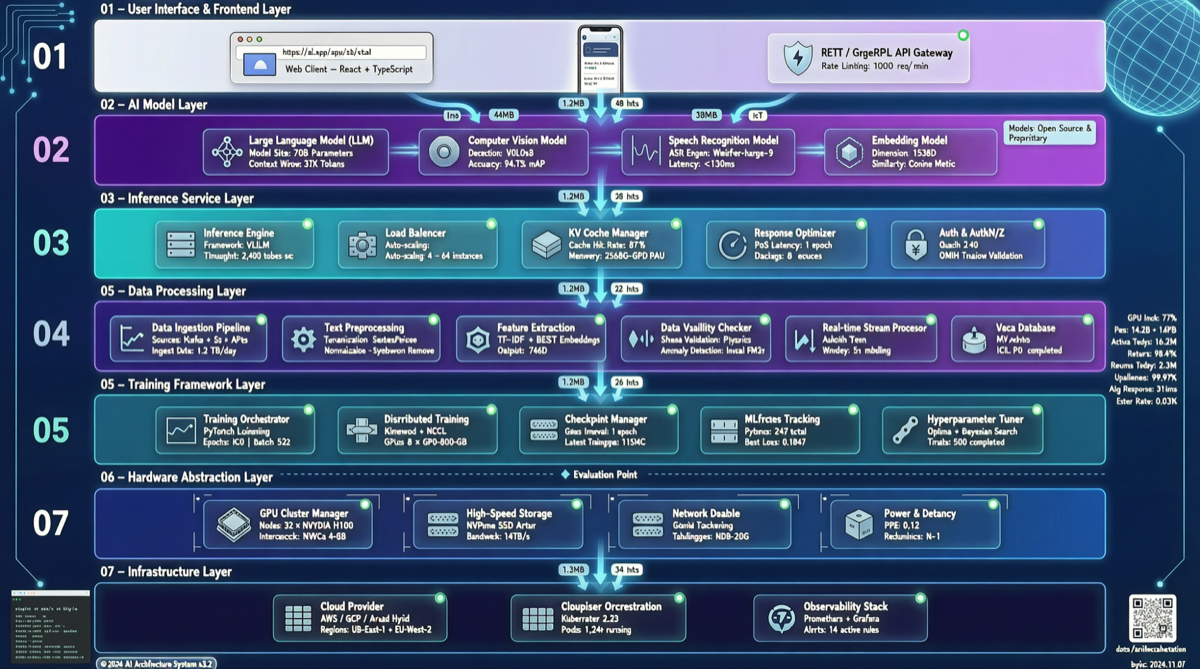
"Most people think AI is one tool."
That tweet got 65 views last week. Not viral, but it nailed a truth: AI in 2026 has become a layered architecture, and every layer is an independent purchasing decision, an independent cost center, an independent failure point.
If you're still thinking about tech selection in terms of "GPT or Claude," your AI project may already be accumulating technical debt in a layer you can't see.
The 2026 AI stack
From top to bottom, it looks roughly like this:
Layer 1: User interface. Web app, CLI, IDE plugin, Slack bot, voice assistant. This layer decides how users interact with AI.
Layer 2: Orchestration. LangChain, OpenClaw, LangGraph, CrewAI. Responsible for task decomposition, routing, error retry, multi-agent coordination.
Layer 3: Model routing. Decides which request goes to which model. Simple question → GPT-4o-mini, complex reasoning → Claude Opus, code → DeepSeek V4. Good routing can cut costs to 40-60%.
Layer 4: Base model layer. GPT, Claude, Gemini, Qwen, DeepSeek, GLM. This is the layer everyone discusses, but it actually accounts for only 30-50% of total cost.
Layer 5: Memory and context. Vector databases (Pinecone, Weaviate, Qdrant), caching (Redis), session management. This layer's cost is chronically underestimated.
Layer 6: Tools and data. MCP servers, API connectors, database query interfaces, filesystem. Whether agents can actually "do things" depends on this layer.
Layer 7: Infrastructure. GPU clusters, inference services (vLLM, TGI), networking, storage.
Seven layers. Each evolving, each with vendor lock-in risk.
The most overlooked layer
Memory (Layer 5).
Most teams spend enormous time on Layer 4 (picking models) and Layer 2 (picking orchestration frameworks), but severely underinvest in memory. The result: AI can answer complex questions but can't remember what the user said last time; or reloads the entire knowledge base for every conversation, inference costs spiking.
A good memory architecture should do three things:
- Keep short-term memory (in-session context) within the model window, avoiding wasted tokens
- Use vector retrieval for long-term memory (cross-session knowledge), loading on demand instead of stuffing everything into the prompt
- Version-control memory updates, otherwise you hit the "AI remembered wrong information and keeps being wrong forever" problem
Where vendor lock-in is most severe
The base model layer. Obvious, but many don't realize — once your prompt engineering, tool call protocols, and output format parsing are all optimized for one model, the cost of switching is much higher than you'd think.
The more hidden lock-in is in orchestration (Layer 2). If you wrote 50 Agent workflows in LangGraph, switching to another orchestration framework means rewriting everything. This is why some teams are adopting "lightweight orchestration + standardized protocols" — using simple state machines instead of heavy frameworks to reduce migration cost.
One practical recommendation
If you're starting to build an AI product, or refactoring an existing AI workflow:
- Define your model routing strategy first, then pick models. Not the other way around.
- Design the memory layer as a first-class citizen, not an afterthought.
- Keep orchestration lightweight. If if-else can solve your routing, don't use a heavy framework.
- Run cost audits regularly. Monthly check of each layer's cost percentage, find abnormal growth points.
Every layer of the AI stack is changing fast. Today's best practice could be outdated in three months. But understanding the stack's structure keeps you clear-headed in the change.
Sources:
- X/Twitter community discussion ("AI is a stack" thread, 2026-05-10)
- Industry analysis synthesis