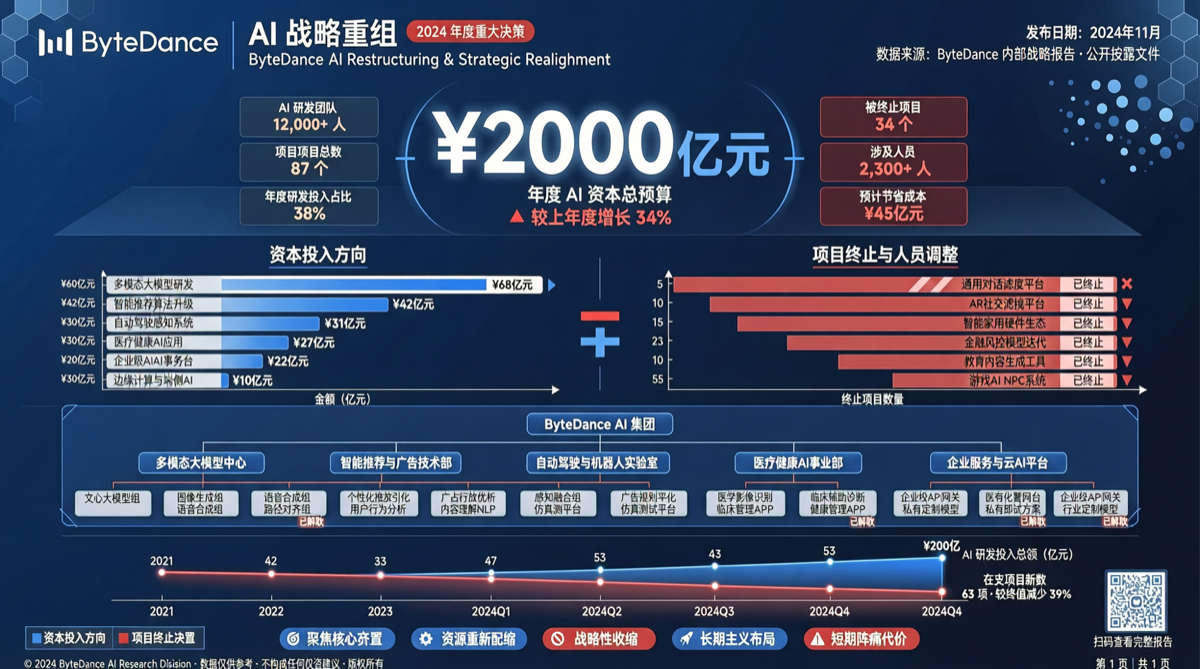
ByteDance is adding 25% to its AI budget this year, reaching 200 billion yuan. Sounds massive, right?
But over the same weekend, another message quietly circulated: ByteDance cut 30% of its AI projects in an internal communication meeting. Dreamina, Cat Box, Star Painting - all product lines once held with high hopes, terminated.
Put these two things together and the message is clear: it is not about having more money, it is about not spreading the money around anymore.
$28 Billion, Half Going to Chips
Of the 200 billion yuan capital expenditure, roughly half (85 billion yuan) is designated for AI processor procurement. The other half goes to computing infrastructure construction and large model R&D.
Compare the numbers to understand how aggressive this is: ByteDance invested about 150 billion yuan in AI in 2025, already nearly double the previous year. Another 50 billion increase in 2026 means three consecutive years of doubling growth.
The memory chip industry is going through a "super cycle" with hardware costs climbing. ByteDance's 25% budget increase is largely being pushed up by memory chip prices. In other words, spending more money may buy roughly the same number of chips as last year.
The 30% That Was Cut Is the Real Story
Budget went up, projects got cut. That is the signal worth paying attention to.
The product lines being cut share common characteristics:
- Non-Doubao ecosystem: Products not tied to the Doubao main brand were almost entirely eliminated
- Weak monetization: AI video, AI writing, AI education - return on investment too low
- Out-of-control burn rate: Reported AI inference costs in 2025 hit 8 billion yuan, 2.3x the related revenue
ByteDance is not trimming - it is zeroing out. Products that do not make money, are not tied to Doubao, and cannot form a data flywheel, all gone.
Doubao's Single Bridge
Now ByteDance's AI strategy has only one main line: Doubao.
The Douyin AI web version has launched, and the Doubao paid subscription system is rolling out. ByteDance wants to consolidate all AI capabilities under one brand, use Douyin's traffic to feed it, and use Doubao's API for external monetization.
This is similar to Tencent and Baidu's approach - concentrate resources on one or two core AI products rather than casting a wide net. ByteDance's advantage is that it has Douyin as a ready-made super distribution channel. Doubao does not need to find users from scratch; it just needs Douyin users to click one more button.
But the problem is obvious: putting all eggs in the Doubao basket means if model capability falls behind (say, Kimi or Qwen overtakes it in key scenarios), ByteDance has no backup plan.
Where Money Flows, Strategy Follows
Of the 200 billion yuan AI spending, 85 billion buys chips. In an environment of tightening chip restrictions, this means ByteDance is stockpiling compute, regardless of what chip models it can get.
This "stockpile first" strategy is essentially a bet on future compute scarcity. ByteDance is gambling that in two years, compute will be more valuable than models.
My take? That judgment is probably right. But stockpiling compute while cutting 30% of product lines also means ByteDance's exploration space at the model level is being significantly compressed. Doubao is everything, there is no Plan B.
Main sources: