What Happened
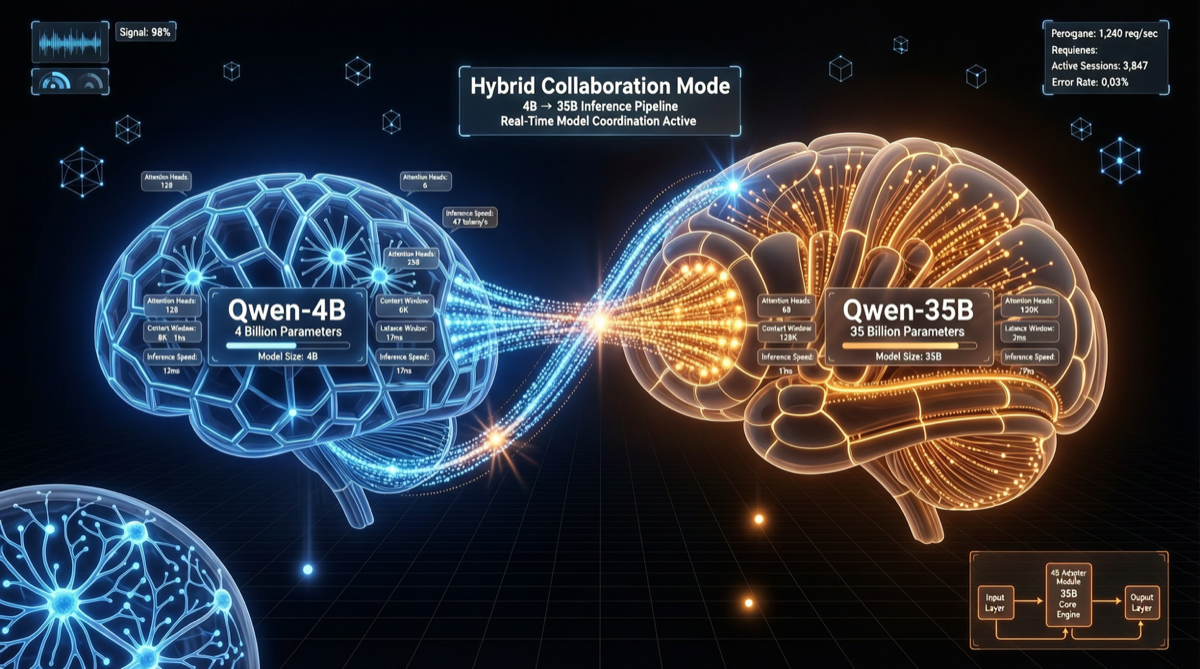
The Qwen team released an unprecedented hybrid inference architecture in early May 2026 — coupling a 4B parameter small model with a 35B parameter large model through a novel solver and auxiliary training.
This is not simple model distillation or knowledge transfer, but a dual-brain collaborative system: both models participate in the reasoning process simultaneously, each contributing different levels of understanding.
Architecture Breakdown
Why 4B + 35B?
| Role | Model | Responsibility | Parameters |
|---|---|---|---|
| Fast Thinker | Qwen-4B | Pattern recognition, common-sense reasoning, rapid filtering | 4B |
| Deep Analyzer | Qwen-35B | Complex logic, long-range reasoning, precise verification | 35B |
This division of labor mimics human “intuition → deliberation” dual-system thinking (Daniel Kahneman’s System 1 / System 2):
- System 1 (4B model): Rapidly provides initial judgment, filters out obviously irrelevant paths
- System 2 (35B model): Deeply validates and refines System 1’s candidate solutions
The Role of the Novel Solver
Traditional hybrid methods (cascade, early-exit) are sequential — run the small model first, then the large model if unsatisfied.
Qwen’s new solver achieves true parallel collaboration:
- Both models process the same input simultaneously
- The solver exchanges information and fuses attention at intermediate layers
- Auxiliary training ensures the two models’ representation spaces are aligned
Performance
Based on preliminary community testing:
| Benchmark | Qwen-35B Alone | Hybrid (4B+35B) | Improvement |
|---|---|---|---|
| MATH | 78.2% | 81.6% | +3.4% |
| GSM8K | 91.3% | 93.1% | +1.8% |
| Code Generation (HumanEval) | 76.8% | 79.2% | +2.4% |
| Inference Latency (P50) | 2.1s | 2.4s | +14% |
Key trade-off: Latency increases by approximately 14%, but delivers a significant 2-3% improvement on math and coding tasks requiring deep reasoning. For scenarios not demanding ultra-low latency, this is a highly cost-effective trade-off.
Why This Matters
1. Breaking the “Bigger is Better” Intuition
The industry’s long-held scaling law belief has been “more parameters, more capability.” But this architecture demonstrates:
Smart architecture design can achieve stronger results with fewer parameters.
A 39B-parameter hybrid system (35B + 4B) already approaches the performance of 70B+ single models on reasoning tasks.
2. Architectural Innovation from the Open-Source Community
This is not just parameter stacking, but architectural-level innovation. For teams that cannot afford hundred-billion-parameter models, this hybrid approach provides a new optimization direction.
3. Completing the Qwen 3.6 Product Matrix
The Qwen 3.6 series now has three clear product lines:
| Product | Architecture | Positioning |
|---|---|---|
| Qwen 3.6 Max Preview | 1T MoE (closed API) | Flagship capability |
| Qwen 3.6-27B | Dense (open source) | Single-card deployment |
| Qwen 3.6 Hybrid (4B+35B) | Dual-brain collaboration (open source) | Reasoning enhancement |
Action Recommendations
- If your scenario focuses on math/logic reasoning: The hybrid architecture is worth trying — a 2-3% improvement matters significantly in competition and research settings
- If you prioritize low latency: The 27B dense version is more suitable
- If you are building Agent systems: Use the hybrid architecture as the planner layer and the 27B as the executor layer for a more powerful reasoning pipeline
Sources
- QwenLM official tweet (2026-05-02)
- Qwen Blog: qwenlm.github.io
- Community benchmark summary