What Happened
A post on X that garnered 410K views and 1,806 likes revealed a widely overlooked AI supply chain risk: 98% of the global supply of ABF (Ajinomoto Build-up Film) is exclusively controlled by Japan’s Ajinomoto Corporation.
This isn’t just another supply chain story — it means every AI chip, whether it’s NVIDIA’s GPU, Google’s TPU, or any manufacturer’s ASIC, must pass through Ajinomoto’s “gate.”
What Is ABF Build-up Film
ABF build-up film is a critical material used in high-performance chip packaging. Its role is to build multi-layer interconnect structures between the chip and the circuit board, enabling high-speed signal transmission.
| Application | Why ABF Is Needed |
|---|---|
| GPU Packaging | High-bandwidth interconnects require multi-layer routing |
| CPU Packaging | High-density pins require fine-pitch traces |
| AI Accelerators | Large chip areas require reliable packaging |
Ajinomoto — yes, the company that makes seasoning — leveraged decades of accumulated expertise in amino acids, resins, and materials chemistry to produce the world’s best ABF build-up film.
Where the Risk Lies
1. Single Supplier
A 98% market share means the entire AI industry hangs on one company. If Ajinomoto’s production line encounters problems (earthquake, fire, equipment failure), global AI chip output will be directly impacted.
2. Production Fully Booked
Ajinomoto’s ABF production lines are fully booked through 2027. This means additional AI chip capacity over the next two years will be physically constrained by packaging material availability — it’s not that there aren’t enough GPU dies, but there isn’t enough ABF to package them.
3. Continuous Price Increases
Supply-demand imbalance directly drives price increases. Ajinomoto is already raising prices, and with no alternatives available, downstream manufacturers have no choice but to accept.
4. Zero Alternatives
The post states “Zero production-ready alternatives.” Other manufacturers are developing alternatives, but none can match Ajinomoto’s quality and capacity for at least 2-3 years.
Industry Impact
Constraints on AI Compute Expansion
While everyone discusses GPU counts, HBM capacity, and interconnect bandwidth, few notice that packaging materials may be the real bottleneck. ABF supply limits effectively cap AI chip output.
Investment Signals
- Short-term bullish for Ajinomoto: Oversupply + no alternatives = pricing power
- Medium-term watch for alternative materials: Whoever breakthroughs ABF technology within 2-3 years becomes the next “water seller”
- Long-term packaging technology route changes: If ABF remains constrained, the industry may accelerate exploration of chiplet, hybrid bonding, and alternative packaging approaches
Landscape Assessment
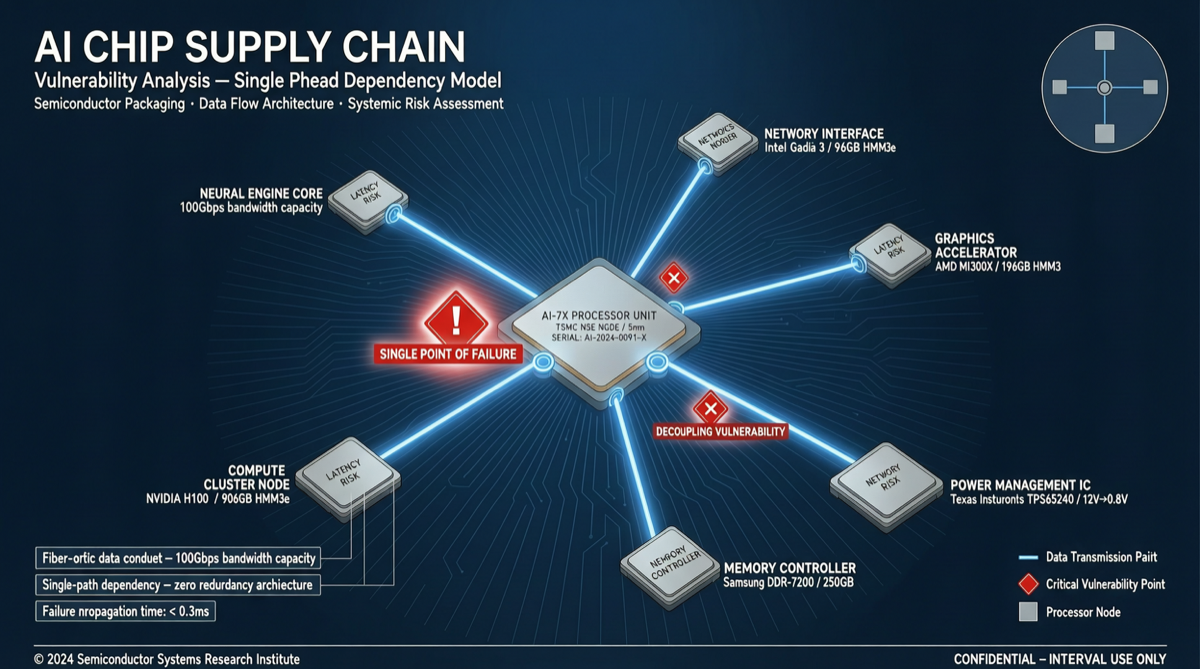
The AI industry’s supply chain is far more fragile than it appears on the surface. From TSMC’s advanced processes, to SK Hynix’s HBM, to Ajinomoto’s ABF — each link could be a single point of failure for the entire industry.
For AI infrastructure investors and practitioners, looking beyond chip design to these “invisible” supply chain nodes is essential. The next AI compute bottleneck may not be inside the chip, but outside it.