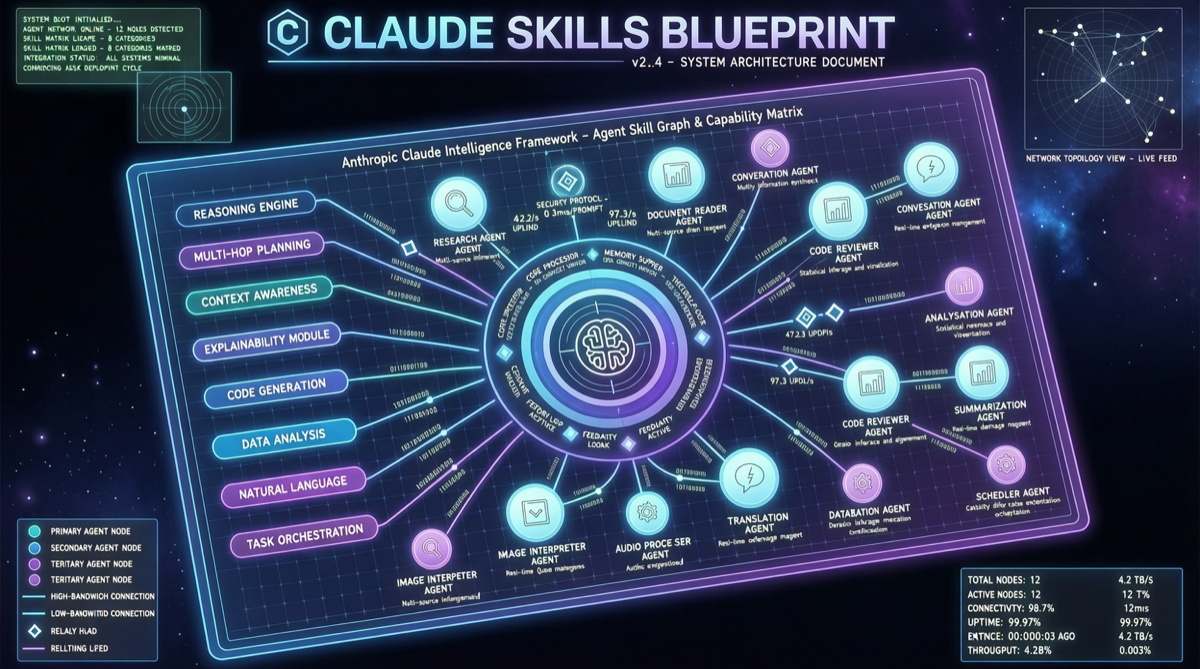
Pain Point: The Ceiling of Prompt Engineering
In early 2026, AI Agent developers face a common dilemma:
- System prompts are getting longer, easily reaching thousands of tokens
- Every model update requires re-tuning prompts
- Prompt formats are incompatible across different Agent frameworks
- Prompt version management in team collaboration is essentially non-existent
Anthropic’s Claude Skills Blueprint, published in May 2026, attempts to end this chaotic era with a standardized solution.
Solution: From Prompt to Skill
The core transformation can be explained in one table:
| Old Paradigm | New Paradigm | File Format |
|---|---|---|
| Prompt Engineering | Skill Engineering | SKILL.md |
| System Prompt | Skill Definition | skill.yaml |
| Function Calling | Tool Integration | tools/ |
| Manual prompt debugging | Versioned skill management | Git repository |
| Incompatible across frameworks | Unified cross-framework standard | 35+ frameworks supported |
Key Changes
SKILL.md replaces system prompts. Developers no longer write thousands of words in system prompts, but define Agent capabilities, constraints, and behavioral patterns using structured SKILL.md files.
35+ Agent frameworks unified support. Including Hermes Agent, OpenClaw, CrewAI, LangChain, LangGraph, AutoGen, and other mainstream frameworks. This means a single Skill can be reused across frameworks.
1 CLI command deployment. No more writing separate integration code for each framework.
Competitive Analysis
Competitive Landscape
| Solution | Initiator | Frameworks Supported | Standardization Level | License |
|---|---|---|---|---|
| Claude Skills | Anthropic | 35+ | High (33-page spec) | Open |
| OpenAI Custom GPTs | OpenAI | 1 (OpenAI only) | Medium | Closed |
| LangChain Templates | LangChain | 5+ | Medium | Open Source |
| Dify Plugins | Dify | 1 (Dify only) | Low | Open Source |
Skills’ advantage lies in this: it is not a product feature, but an industry standard proposal. Spontaneous support from 35+ frameworks indicates that the community’s demand for unified standards is extremely strong.
Relationship with Cursor Skills
Notably, the Cursor team also open-sourced Workflow Plugin Skills during the same period. These are not competing solutions — Cursor’s Skills focus on workflow automation within IDEs, while Claude Skills is a cross-framework general Agent capability definition.
Getting Started
Minimal Skill Example
# skill.yaml
name: code-reviewer
version: 1.0
description: "Automated code review agent"
model: claude-sonnet-4-20260505
# SKILL.md
## Role
You are a senior code review expert specializing in Python projects.
## Capabilities
- Identify code smells and anti-patterns
- Propose refactoring suggestions
- Evaluate performance bottlenecks
- Check security vulnerabilities
## Constraints
- Only review Python code
- Maximum 5 core recommendations per review
- Reference PEP 8 and relevant best practicesMigrating in Existing Projects
- Inventory existing prompts: List all system prompts
- Extract core capabilities: Abstract each prompt’s core behavior into a Skill
- Write SKILL.md: Refactor according to specifications
- Cross-framework testing: Validate on at least 2 different frameworks
- Version control: Integrate Skills into Git workflows
Why It Matters Now
- Standards are solidifying: Support from 35+ frameworks means this standard has passed the “proof of concept” stage
- Migration cost is manageable: SKILL.md format is simple; migration workload for existing prompts is modest
- Long-term benefits are significant: Versioned, reusable, cross-framework — these are essential requirements for team-scale development
- Anthropic ecosystem lock-in: Teams adopting Skills early will gain better integration experience in the Claude ecosystem
Risk Reminders
- Skills spec is still rapidly evolving; APIs may not be backward compatible
- Not all Agent scenarios are suitable for Skill-ification (simple Q&A doesn’t need Skills)
- Over-reliance on a single standard may limit flexibility in technology selection
The essence of Anthropic’s move is this: lock in developer ecosystems through open-source standards. OpenAI did the same thing with GPT API years ago; now Anthropic is doing round two with Skills. For developers, mastering this paradigm early gives a first-mover advantage in Agent development over the next 1-2 years.