What Happened
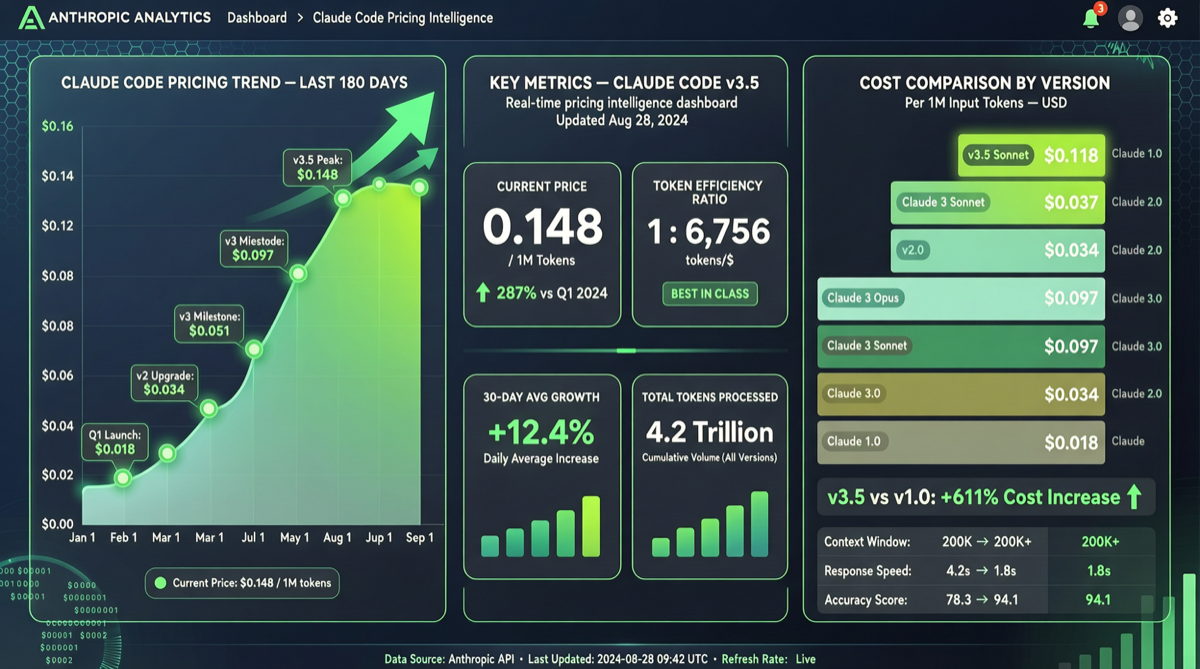
Anthropic quietly updated a key figure in its Claude Code official documentation: the estimated daily usage cost for enterprise developers rose from $6 to $13, while the 90th percentile daily spending cap increased from $12 to $30.
The previous estimate was based on Sonnet 3.7 as the primary model. The new figures reflect changes in actual user behavior patterns — more users switching to Opus-level models and increased token consumption per session.
| Metric | Old Estimate | New Estimate | Change |
|---|---|---|---|
| Average daily cost | $6 | $13 | +117% |
| 90th percentile daily cap | $12 | $30 | +150% |
| Estimation baseline model | Sonnet 3.7 | Current mixed usage | Model upgrade |
Why It Matters
Signal 1: User Behavior Is Migrating to “Heavy Mode”
The most direct reason for doubled costs is that users are using Claude Code more deeply. Early adopters may have used it for simple code completion and small refactors with limited token consumption. But now:
- More users treat Claude Code as their primary coding environment rather than an auxiliary tool
- Session task scale has upgraded from “modify a function” to “refactor an entire module”
- Opus-level model usage has increased significantly — stronger reasoning means higher token unit price
This is a sign of product maturation, not a negative signal. Shallow usage means low cost but also low value; deep usage means high cost but greater engineering output.
Signal 2: Anthropic Is Moving from “Promotion Phase” to “Commercialization Phase”
The $6/day estimate was essentially a marketing number — it made enterprise decision-makers think “cheap, worth trying.” The $13/day is an operational number — it’s closer to actual bills, helping CTOs make real budget plans.
Anthropic’s choice to update now implies:
- Claude Code has crossed the market education phase — no longer needs the lowest cost estimate to attract users
- Enterprise procurement needs real numbers — budget approval is based on actual expectations, not optimistic estimates
- Cost transparency is part of trust building — better to give conservative estimates upfront than surprise users with unexpected bills
Signal 3: $390-$900/Month Coding Assistant Is Reshaping Developer Tool Pricing Anchors
At the new estimate, Claude Code’s monthly cost is approximately $390 (daily $13 x 30 days), with heavy users potentially reaching $900 (daily $30 x 30 days).
This price range means:
- Claude Code has moved beyond traditional developer tool pricing (IDE subscriptions typically $10-$30/month)
- It is now competing with the marginal cost of a junior developer — even at $900/month, it’s far below any region’s human engineer cost
- For heavy users, a $42,000/year Claude Code bill is not impossible — but it’s still far below hiring an additional engineer
Landscape Assessment
The upward revision of Claude Code cost estimates is fundamentally a positive signal: it shows the product is being used more deeply, with users transitioning from “let’s try it” to “truly dependent.”
Compared to OpenAI Codex and Cursor’s pricing strategies, Anthropic’s choice appears more pragmatic: not promising the lowest cost, but giving a range closer to reality. This transparency helps build enterprise customer trust in the long run.
For individual developers, the $13/day average cost means seriously evaluating return on investment. If your codebase is small and tasks are simple, Sonnet level may suffice; if you’re refactoring a large system, the $13/day investment is likely worthwhile.
Actionable Recommendations
| Your Situation | Recommendation | Expected Monthly Cost |
|---|---|---|
| Individual developer, small projects | Use Sonnet level, control context scope | ~$100-$200 |
| Team developer, medium projects | Mix Sonnet + Opus, allocate by task | ~$300-$500 |
| Enterprise, large codebases | Full Opus with Skills and automation | ~$500-$900 |
| Cost-sensitive teams | Limit Claude Code to high-value tasks, use cheaper models for daily coding | ~$100-$300 |
Core principle: Claude Code’s cost is proportional to the value it produces. The deeper you use it, the higher the bill, but the greater the engineering efficiency gain. The key is choosing the right model tier for different tasks — avoid using Opus for simple work that Sonnet could handle.