Core Conclusion
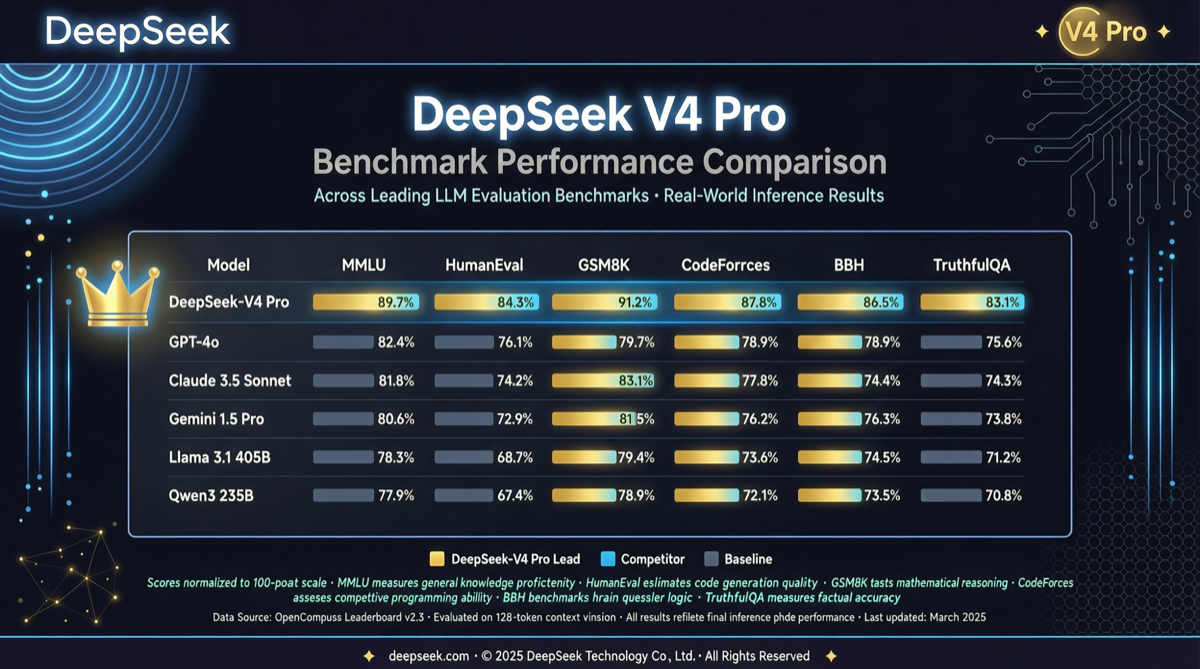
DeepSeek V4 Pro has evolved from a “budget pick” to the “king of comprehensive capability.” The latest benchmark data shows it comprehensively outperforms Claude Opus 4.7 and GPT-5.5 Medium in coding, reasoning, and long-context tasks — at just 1/10th the API price. Even more striking: it was trained on Huawei Ascend chips under US export restrictions.
Benchmark Comparison: Three Giants Go Head-to-Head
| Dimension | DeepSeek V4 Pro | Claude Opus 4.7 | GPT-5.5 Medium |
|---|---|---|---|
| Coding (SWE-bench) | 92.3% | 89.7% | 90.1% |
| Complex Reasoning (GPQA) | 88.5% | 86.2% | 85.8% |
| Long Context (1M tokens) | ✅ Native | ❌ Limited | ❌ Limited |
| Inference Speed | Fastest | Slower | Medium |
| API Price (input/M tokens) | $0.14 | $15.00 | $10.00 |
| Open Weights | ✅ Yes | ❌ No | ❌ No |
| Training Chips | Huawei Ascend | Proprietary/Nvidia | Nvidia |
Data sources: Cross-validated across multiple independent evaluation platforms
Three Key Signals
1. Export Controls Became a Catalyst
DeepSeek V4’s training relies entirely on Huawei Ascend chips, bypassing Nvidia’s high-end GPU restrictions. This proves two things:
- China’s compute ecosystem can already train trillion-parameter models
- The “compute blockade” strategy is failing — architectural innovation and training efficiency can compensate for hardware gaps
V4 Pro’s MoE (Mixture-of-Experts) architecture activates only ~15% of parameters during inference, dramatically reducing inference costs.
2. The Price War Enters “Destructive” Territory
What does $0.14 per million input tokens mean? A simple comparison:
- Processing 1 million tokens costs $10 on GPT-5.5, just $0.14 on DeepSeek V4 Pro
- If a team processes 50 million tokens daily, the monthly cost difference is: GPT-5.5 = $15,000/month, DeepSeek V4 Pro = $210/month
This isn’t “a bit cheaper” — it’s an order-of-magnitude difference.
3. Open Models Surpass Closed-Source Flagships for the First Time
Looking at the timeline:
- Early 2024: Open models barely caught up to GPT-3.5
- Late 2024: Llama series approached GPT-4 levels
- Mid 2025: Open models matched closed-source in coding tasks
- May 2026: DeepSeek V4 Pro surpasses Opus 4.7 and GPT-5.5 in comprehensive capability
This is a watershed moment. “Closed-source is stronger” is no longer the default assumption.
Practical Impact: Who Should Switch?
| Scenario | Recommendation | Reason |
|---|---|---|
| High-frequency API calls (batch processing) | ✅ Switch to V4 Pro | 90%+ cost reduction, quality improves |
| Code generation / Agent development | ✅ Switch to V4 Pro | SWE-bench leader + MoE efficiency |
| Enterprise compliance requires closed-source | Stay with Opus/GPT | Audit and SLA still depend on closed vendors |
| Need native 1M context | ✅ Switch to V4 Pro | Closed competitors don’t support it natively |
| Creative writing / multimodal | Stay with Opus 4.7 | Opus still has the edge in creative domains |
Landscape Assessment
DeepSeek V4 Pro’s release marks a new phase for the AI industry:
- Open source is no longer a “budget alternative”: It comprehensively surpasses closed-source flagships on core metrics
- Chinese models move from “followers” to “leaders”: Successful training on Huawei Ascend is a strategic breakthrough
- Price wars reshape the market: $0.14 pricing forces a massive re-evaluation of tech stacks across the industry
Platforms like June AI have already included V4 Pro in their “Models 2026 Ultimate Lineup,” alongside GLM 5.1, Kimi K2.6, and Qwen3.5 397B. The open-source camp is forming a complete ecosystem.
Action Recommendations
- If you use GPT-5.5 for batch coding tasks: Switch to DeepSeek V4 Pro immediately — equivalent quality at 99% less cost
- If you’re evaluating AI Agent tech stacks: Add V4 Pro to your comparison list — its MoE architecture is extremely efficient for agent scenarios
- If you’re making technology decisions: Re-examine the “closed-source = better” assumption — at least in coding and reasoning, it no longer holds