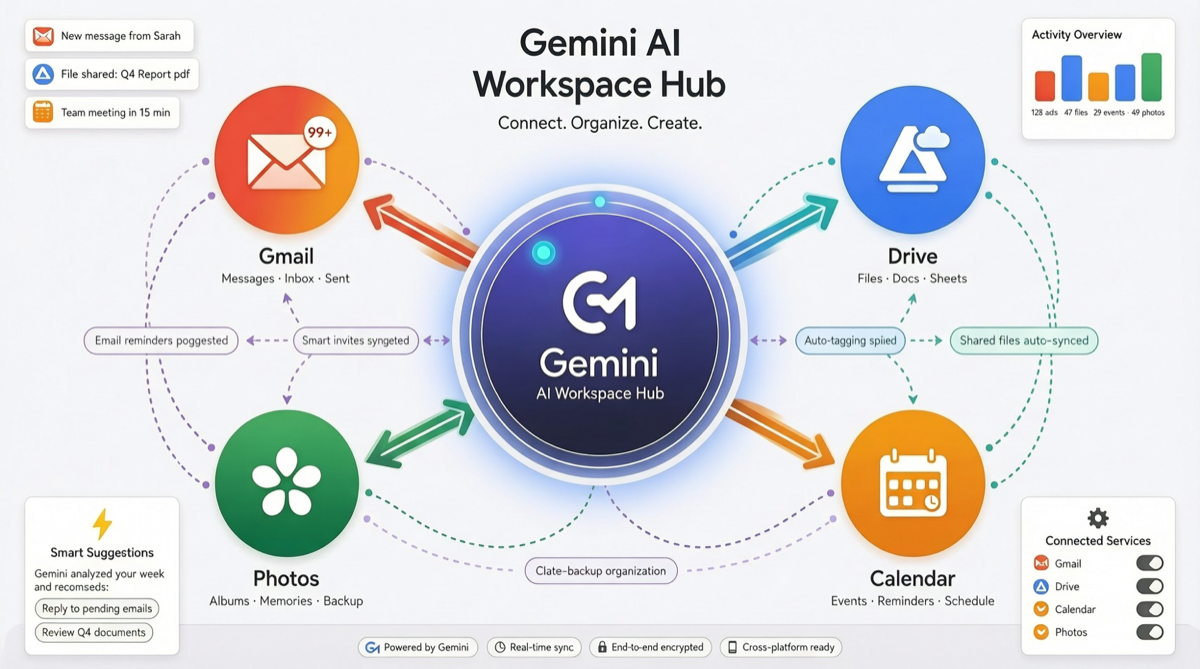
Bottom Line First
Google pushed a series of Gemini updates in April — no press conference, no massive PR. But this “quiet drop” style reveals a fact: Google is systematically building Gemini’s Agent capabilities and has reached a stage of continuous iteration.
7 upgrades fall into 3 categories:
- Memory & Knowledge Management: Notebooks + NotebookLM sync
- Personalization & Context Awareness: Personal Intelligence + Google Photos
- Workflow Integration: Gmail/Drive/Calendar deep reading + AI music
7 Upgrades Breakdown
Category 1: Memory & Knowledge
1. Notebooks → Personal AI Knowledge Base
Gemini’s Notebooks allow users to persist conversation content as project-level knowledge bases. Unlike one-off conversations, Notebook content can:
- Cross-session reference
- Team sharing
- Project/topic classification
2. NotebookLM Direct Sync
Gemini Notebooks can now directly sync with NotebookLM projects. You can brainstorm in Gemini while NotebookLM processes uploaded documents in the background — both sides auto-sync.
Category 2: Personalization
3. Personal Intelligence Global Rollout
Personal Intelligence connects your calendar, email, photos for highly personalized answers:
- “What free time do I have this week for meetings?” → Reads calendar
- “Organize last week’s trip photos” → Reads Google Photos
- “Recommend weekend activities based on my interests” → Analyzes history
4. Google Photos Image Personalization
Gemini now reads from Google Photos and generates personalized image processing based on your life, interests, and focus points.
Category 3: Workflow
5. Gmail Deep Reading
- Summarize unread emails
- Priority sorting
- Draft replies
- Extract key info (dates, locations, action items)
6. Drive Document Integration
- Analyze reports and spreadsheets in Drive
- Generate new content based on existing documents
- Cross-document info retrieval
7. Calendar Schedule Management
- Find available time slots
- Create/modify schedules
- Auto-create calendar events from email content
Google’s Agent Strategy Puzzle
Looking at April updates in the bigger picture, Google’s Agent strategy is taking shape:
8th Gen TPU (Compute Foundation)
    ↓
Gemini Enterprise Agent Platform (Enterprise Agent Platform)
    ↓
Agentic Data Cloud (Data Autonomous Action Layer)
    ↓
Workspace Intelligence (Office Scenario Integration)
    ↓
Personal Intelligence (Personal Scenario Integration)
This is a full-stack Agent strategy from infrastructure to application scenarios. Unlike Anthropic’s focus on “coding agents” (Claude Code) and OpenAI’s “general chat agents” (ChatGPT), Google’s advantage is owning the complete personal and enterprise data ecosystem — Gmail, Drive, Calendar, Photos, Workspace.
Competitor Comparison
| Dimension | Gemini | Claude | ChatGPT |
|---|---|---|---|
| Coding | Medium | Best | Strong |
| Personal Data Integration | Best | Weak | Medium |
| Enterprise Data Integration | Best (Workspace) | Weak (3rd party) | Medium (Copilot) |
| Multimodal | Strong | Strong | Strong |
| Open Source | Partial (Gemma) | None | Partial |
| Memory System | Notebooks | Memory | Memory |
Google’s core competency is data ecosystem completeness — difficult for Anthropic and OpenAI to replicate short-term.
Action Recommendations
If you’re a Google Workspace user:
- Immediately test Gemini + Gmail + Drive + Calendar integration workflow
- Store common templates in NotebookLM
- Enable Personal Intelligence when available
If you use Claude or ChatGPT as primary:
- Evaluate if your workflow involves heavy Google ecosystem data
- If yes, Gemini’s integration may be worth switching or hybrid use
- Coding still favors Claude Code, but document processing Gemini excels
Based on Google official blog and community information. Some features may vary by region.