Core Conclusion
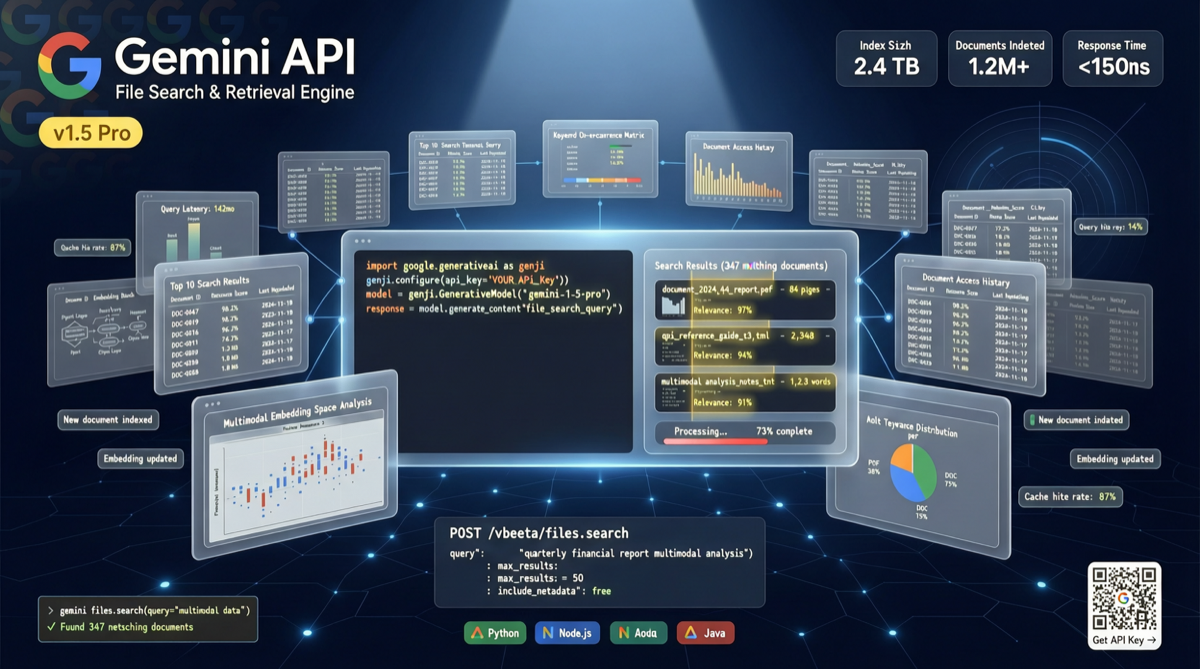
Google released three key updates for Gemini API File Search (File Search) on May 5: native image + text processing, custom metadata retrieval, and page-level citations. These updates directly address core pain points of multimodal RAG applications, significantly enhancing Gemini API’s competitiveness in this area.
Three Updates in Detail
1. Native Image and Text Joint Processing
Previously, Gemini API’s file search primarily targeted text documents. After the update, the system can process both image and text content simultaneously and search within a unified index space.
Application Scenarios:
- Simultaneous retrieval of text and charts in scanned documents (PDF + images)
- Joint search of screenshots and explanatory text in product manuals
- Associated retrieval of images and diagnostic text in medical imaging reports
Technical Significance: No longer need to build a separate visual search pipeline (such as CLIP embedding) for image content. Gemini handles everything uniformly at the file search layer. This reduces the architectural complexity of multimodal RAG systems.
2. Custom Metadata for Accelerated Retrieval
Developers can now attach custom metadata tags to uploaded files, which can be used for filtering and acceleration during search.
# Example: File upload with metadata
file = client.files.upload(
    file=pdf_document,
    metadata={
        "department": "engineering",
        "document_type": "spec",
        "version": "2.1",
        "language": "zh-CN"
    }
)
Application Scenarios:
- Filtering by department/type/version in enterprise document management systems
- Language-tagged retrieval for multilingual documents
- Time range filtering (combined with file timestamp metadata)
3. Page-Level Citations for Precise Grounding
Search results can now return page-level precise citations, not just document-level.
What this means for RAG applications:
- Answers can precisely indicate the specific page of the source information
- Users can one-click jump to the corresponding position in the original text
- Scenarios requiring precise citations, such as legal and medical, are directly supported
Comparison Analysis
| Capability | Before Update | After Update |
|---|---|---|
| Content Types | Text-focused | Native image + text joint processing |
| Metadata Support | None | Custom tags, filterable during search |
| Citation Precision | Document-level | Page-level |
| Multimodal Pipeline | Requires external CLIP etc. | Built-in unified processing |
Comparison with Other Multimodal RAG Solutions
| Solution | Multimodal Processing | Citation Precision | Metadata | Deployment Complexity |
|---|---|---|---|---|
| Gemini API File Search | ✅ Native | ✅ Page-level | ✅ Custom | Low (API call) |
| Gemini Embedding 2 + Vector DB | ✅ Self-built | ❌ Self-implemented | ✅ Self-managed | Medium |
| Pinecone + CLIP | ✅ Self-built | ❌ Self-implemented | ✅ | Medium-High |
| LangChain RAG Pipeline | ✅ Configurable | ⚠️ Depends on implementation | ✅ | High |
Key Judgment: Gemini API File Search is evolving into a “one-stop multimodal RAG backend.” If your application scenario centers on document retrieval and Q&A, using Gemini API directly costs less than building a self-made RAG pipeline.
Landscape Assessment
Google is upgrading Gemini API from a “model interface” to “AI infrastructure.” File search, embeddings, agent toolchains — these are no longer single model calls, but complete AI application building blocks.
Combined with the upcoming release of Gemini 3.2 Flash before Google I/O ‘26 (knowledge cutoff January 2026), Google’s AI developer ecosystem is forming a closed loop:
- Model Layer: Gemini 3.x series (Flash/Pro)
- Embedding Layer: Embedding 2 (unified multimodal embedding space)
- Retrieval Layer: File Search (multimodal file search + page-level citations)
- Application Layer: Gemini Chat / Notebooks / Projects
For developers, this means the friction of building AI applications within the Google ecosystem is significantly decreasing.
Action Recommendations
| Role | Recommendation |
|---|---|
| RAG Developers | If your application involves document search + Q&A, prioritize testing the new features of Gemini API File Search. Page-level citations can be directly used for answer sourcing |
| Multimodal Application Developers | Native image + text processing capability can replace part of self-built visual search pipelines, reducing architectural complexity |
| Enterprise Users | Custom metadata feature enables Gemini File Search to directly integrate with enterprise document management systems, filtering by department/type/version |