What Happened
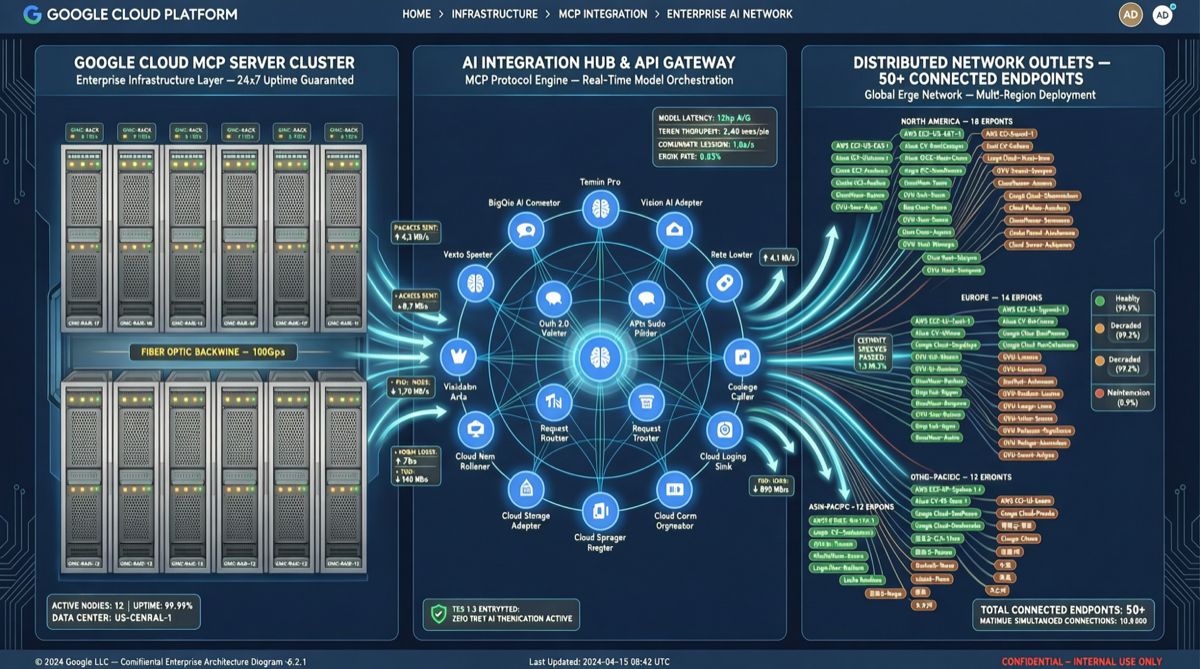
Google Cloud officially announced the release of 50+ MCP (Model Context Protocol) servers on May 5, covering its core cloud service matrix. These MCP servers are officially maintained by Google and come with native governance and observability capabilities, marking a new phase where enterprise-grade Agent integration is becoming standardized and scaled.
Covered Core Services
| Service Category | Representative MCP Server | Function |
|---|---|---|
| Data Warehouse | BigQuery MCP | SQL queries, data analysis, data pipeline management |
| Relational Database | AlloyDB MCP | Database operations, schema management |
| AI/ML | Vertex AI MCP | Model invocation, fine-tuning, deployment |
| Infrastructure | Cloud Run MCP | Service deployment, scaling management |
| Storage | Cloud Storage MCP | File management, permission control |
| Security | IAM MCP | Identity and permission management |
| Monitoring | Cloud Monitoring MCP | Metrics queries, alert management |
Why Now
The MCP Protocol Tipping Point
The Model Context Protocol was proposed by Anthropic in late 2024, with the original intent of providing a unified tool invocation interface for AI models. After a year and a half of development, MCP has become the de facto standard for Agent tool integration:
- Mainstream models including Claude, GPT, and Gemini all support MCP
- The open-source community has already built hundreds of third-party MCP servers
- Enterprises are now demanding production-grade governance capabilities from MCP servers
Google’s large-scale release of MCP servers is a direct response to this trend — rather than letting the community develop them in a scattered manner, Google is providing unified, officially maintained, quality-guaranteed solutions.
Comparison with Other Vendors
| Vendor | MCP Server Count | Governance Support | Open Source | Update Frequency |
|---|---|---|---|---|
| Google Cloud | 50+ | ✅ Native built-in | ✅ Partially open | Continuous |
| Anthropic | 10+ | ✅ | ✅ | Quarterly |
| OpenAI | 5+ | ⚠️ Partial | ❌ Mostly closed | Irregular |
| Community (MCP.so) | 500+ | ❌ Varies | ✅ | Community-driven |
Google’s strategy is clear: build enterprise customer confidence through quantity and quality. 50+ official MCP servers cover the most commonly used cloud service scenarios for enterprises, and the built-in governance capabilities address the compliance and security concerns that enterprises face when deploying Agents.
Governance and Observability: What Enterprises Care About Most
The most noteworthy design of these MCP servers is their native built-in governance and observability:
- Permission Control: Each MCP server supports fine-grained permission management; Agents can only access authorized resources
- Audit Logging: All Agent operations are recorded, meeting enterprise compliance requirements
- Rate Limiting: Prevents accidental or malicious high-volume calls from Agents
- Error Tracking: Complete error stacks and retry mechanisms when MCP calls fail
This means enterprises can directly deploy AI Agents in production environments without building additional security layers.
How to Use It
If you are using Google Cloud:
- Existing Claude and GPT Agents can directly operate BigQuery, AlloyDB, and other services through MCP
- Google has a live tutorial on the AlloyDB and BigQuery MCP toolbox on May 5
- Enterprises can quickly build data-driven Agent workflows based on these MCP servers
If you are using other cloud platforms:
- MCP is an open protocol; Google’s implementation defines the enterprise-grade MCP standard to some extent
- You can reference their governance and observability design patterns in your own MCP servers
- AWS, Alibaba Cloud, and other cloud providers are expected to follow with similar large-scale MCP releases
If you are developing Agent applications:
- Using these official MCP servers can significantly reduce integration workload
- Built-in governance makes Agent applications easier to pass enterprise security reviews
- Combined with Agent frameworks like Hermes and OpenClaw, you can quickly build multi-Agent collaboration systems
Landscape Assessment
Google’s large-scale release of MCP servers is an industry signal: Agent integration is moving from “can we connect” to “can we safely use it in production.”
For developers and enterprises, this means:
- MCP server selection is no longer just a functionality question, but a question of governance capability and security standards
- Officially maintained MCP servers will become the enterprise choice; community MCP servers will be used more for experiments and prototypes
- Competition among cloud providers will partially shift to the richness and quality of MCP ecosystems
Next, it will be worth watching whether AWS and Alibaba Cloud follow up with official MCP server matrices. If a three-way rivalry forms, MCP’s position as the Agent tool integration standard will be further consolidated.