Bottom Line First
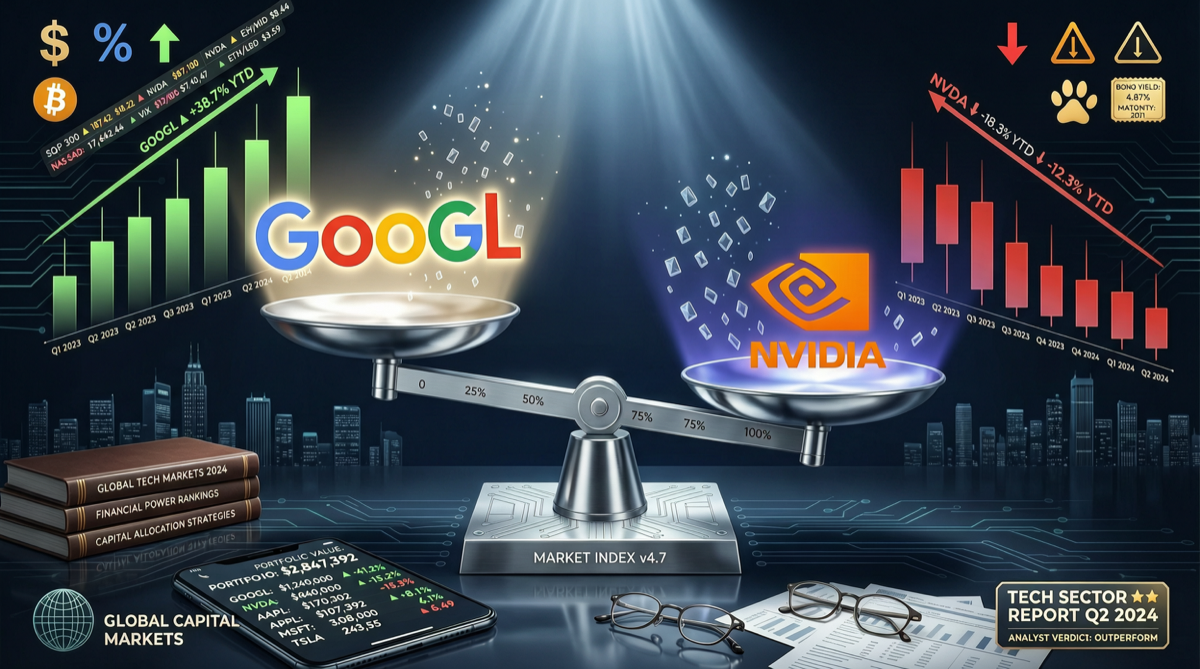
On May 6, 2026, a landmark event occurred: Alphabet (Google) officially surpassed NVIDIA as the world’s most valuable company.
This is not an ordinary ranking change. It sends a clear signal: the value center of the AI industry is shifting from “chip manufacturers selling picks” to “platform companies controlling data, models, and distribution channels.”
Event Background
| Company | Current Market Cap (approx.) | Core Driver |
|---|---|---|
| Alphabet (GOOGL) | ~$4.3 trillion | Gemini ecosystem, Google Cloud AI, search ads, Android |
| NVIDIA (NVDA) | ~$4.26 trillion | AI chips, CUDA ecosystem, data center GPUs |
| Apple (AAPL) | ~$3.5 trillion | iPhone ecosystem, Apple Intelligence |
| Microsoft (MSFT) | ~$3.4 trillion | Azure + OpenAI, Office AI |
| TSMC | ~$1.76 trillion | Chip foundry, advanced process nodes |
Data source: Chip industry market cap rankings as of April 2026
Why Google, Not Another Company
To understand this shift, we need to look at the evolution of the AI industry value chain:
Phase 1 (2022-2024): The “Selling Picks” Era
- NVIDIA was the biggest winner. Every AI company needed GPUs
- Market cap surged from ~$500B to $4T+
- Narrative core: Compute is power
Phase 2 (2025-2026): The “Platform Monetization” Era
- GPU supply is gradually becoming sufficient, prices are dropping
- Value shifts from “who has the chips” to “who makes money with the chips”
- Google’s advantages are now fully visible:
- Search Ads: AI-enhanced search maintains advertising revenue moat
- Google Cloud: Gemini-driven AI services growing rapidly
- Android Ecosystem: AI entry point for billions of devices
- Data Advantage: Massive training data from search, YouTube, Gmail
NVIDIA’s Fundamentals Haven’t Deteriorated
It’s important to emphasize that NVIDIA’s fundamentals remain strong:
- AI chip demand continues to grow
- CUDA ecosystem barrier is solid
- Blackwell architecture supply can’t meet demand
Being surpassed in market cap doesn’t mean failure — it reflects capital markets’ reallocation of future growth expectations.
Deeper Implications
1. The Beginning of Compute Commoditization
When GPUs go from scarce to abundant, their pricing power inevitably declines. NVIDIA’s challenge isn’t “nobody is buying GPUs” — it’s “are GPU margins sustainable?“
2. Data and Distribution Rights Are the Ultimate Moat
Google has the world’s largest-scale real-time user behavior data (search queries, video viewing, email communications) — these are exclusive fuels for training and iterating AI models. Chips can be bought; data cannot.
3. The Impact of Open-Source Models
Google’s Gemma series of open-source models lowers the barrier to AI usage while maintaining competitiveness of commercial APIs. This “open-source + commercial” dual-track strategy is being emulated by more and more companies.
Implications for Other Players
| Company/Direction | Implication |
|---|---|
| OpenAI/Claude | Pure model companies need to accelerate platform transformation (OpenAI has already formed the Deployment Company) |
| Chinese AI companies | Cannot just build models — must establish their own application scenarios and data closed loops |
| AI startups | Vertical scenarios + proprietary data > general model capabilities |
| Chip investors | Focus on AI ASIC custom chip space (Google TPU, Amazon Trainium) |
What to Watch Next
- Google I/O 2026 (May 19-20): May release Gemini Omni and other new models
- NVIDIA’s next quarter earnings: Is data center revenue growth slowing?
- AI CapEx trends: If Google/Microsoft/Amazon reduce GPU procurement, NVIDIA will be directly impacted
This market cap transition is not just a numbers game — it’s a significant milestone in AI industry maturity. When the “AI infrastructure builder” is surpassed by the “AI application giant,” it signals that AI has moved from the infrastructure construction phase into the value monetization phase.