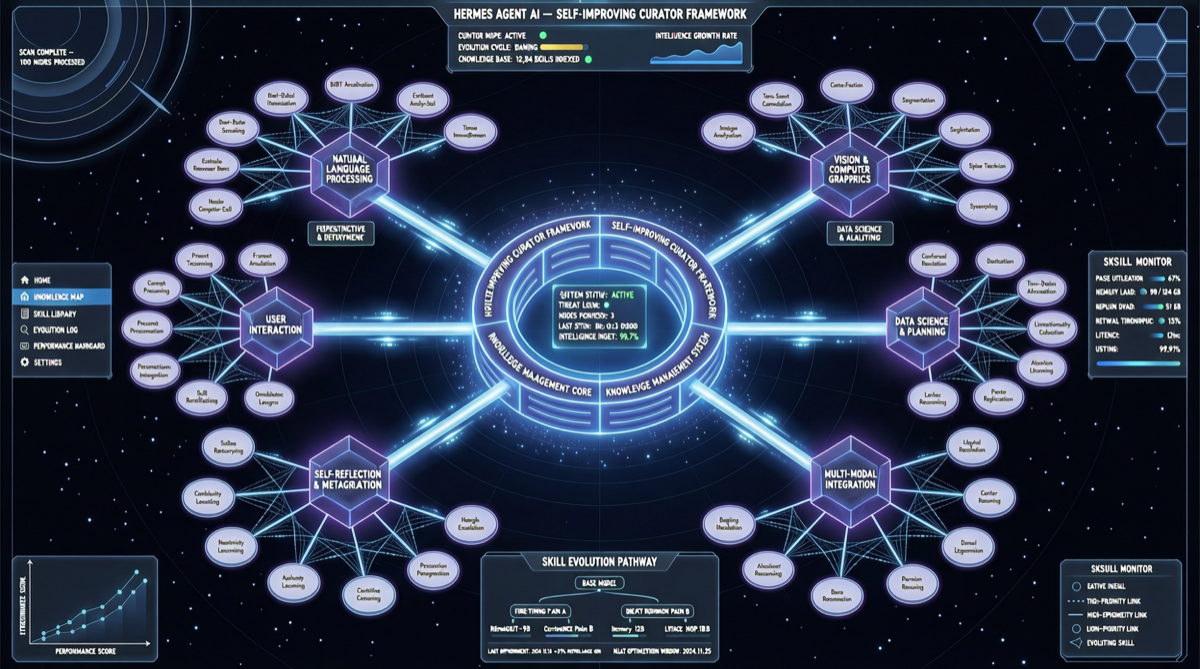
The competition among open source AI agent frameworks is entering an entirely new dimension. Nous Research’s Hermes Agent released v0.12.0 just five days ago, codenamed “Curator Release” — 1,096 commits, 550 merged PRs, over 217,000 lines of code changes, and 213 community contributors involved. This is not a routine iteration — it’s an architectural-level evolution.
Hermes Agent has now surpassed 133k Stars on GitHub, with over 20.3k forks, 3k issues, and 5k+ pull requests — behind these numbers lies the open source community’s genuine vote of confidence in a framework for “agents that grow with you.”
v0.12.0 Core Highlight: The Curator Arrives
The centerpiece of v0.12.0 is Curator — an autonomous agent. This is not a gimmick feature; it’s a real background agent that runs on a 7-day cycle to perform the following tasks:
- Skill library grading: Curator scores and ranks your accumulated skill library
- Skill consolidation and pruning: Automatically merges related skills and retires dead ones
- Archive classification: Uses model + heuristics to classify archived skills as “consolidated” vs “pruned”
- Report generation: Automatically generates an execution report after each run, documenting skill library changes
This means your agent is no longer just “passively executing tasks” — it starts proactively managing its own knowledge and capability boundaries.
Defense-in-depth protection mechanisms ensure that bundled and Hub skills cannot be accidentally mutated. Users can view skill usage rankings (most-used / least-used) via hermes curators list, and specify which model the Curator uses in the configuration file.
Self-Improvement Review Loop: From “Free-Form” to “Rubric-Based”
Hermes Agent’s self-improvement mechanism is the core differentiator of this framework. v0.12.0 delivers a comprehensive upgrade to the background review fork:
Before: Review logic was relatively free-form — the model decided on its own what memories and skills to save, with inconsistent update patterns.
Now:
- Rubric-based review (class-first): The review process now uses a standardized scoring system instead of free-form generation
- Active-update bias: Prefers updating skills the Agent just loaded, avoiding the “learn but never use” problem
- Sub-file support: Properly handles
skill-name/sub-skillsub-file structures - Parent runtime inheritance: Ensures provider, model, and credentials are correctly propagated to the review fork
- Toolset restrictions: The review fork is limited to memory + skills toolsets, preventing “review spawning new skills” from causing infinite sprawl
- Clean context: Prior-turn tool messages are excluded from the review summary, so the review agent sees a clean context
This is the critical step that takes “agent self-evolution” from concept to engineering practice.
Ecosystem Expansion: From Coding Tool to Full-Stack Agent Platform
v0.12.0 is not just a version number bump — it transforms Hermes Agent from a “coding assistant tool” into a “full-stack agent platform.”
ComfyUI and Tou: From Optional to Default Integration
ComfyUI’s MCP integration has been upgraded from “optional plugin” to built-in by default, with new GLSL, post-FX, audio, and geometry support, plus 9 new reference documents. This means multimodal content generation can now be done directly through the Agent.
Tou has similarly been upgraded from optional to default integration, covering a richer set of interaction scenarios.
Inference Provider Expansion
4 new inference providers were added, further expanding the range of inference backends supported by Hermes Agent. For users running multi-model, multi-cloud deployments, this means more flexible model selection options.
Messaging Platforms and Integrations
- The 18th messaging platform is now officially supported, with a 19th via the Teams plugin
- Native Spotify integration and Google Meet integration
Hermes Agent is evolving from a “developer tool” into an “AI assistant for daily work” — it can help you write code, manage meetings, play music, and process messages.
Startup Speed Optimization
TUI cold start time has been reduced by approximately 57%. For developers who frequently open terminals, this is the most perceptible experience improvement.
Horizontal Comparison with Other Agent Frameworks
| Dimension | Hermes Agent | Claude Code | Cursor Agent | OpenClaw |
|---|---|---|---|---|
| Stars | 133k | 35k+ | 120k+ | 15k+ |
| Self-Evolution | ✅ Curator + Review Loop | ❌ | ❌ | Partial |
| Self-Managed Skills | ✅ Autonomous grading/consolidation/pruning | ❌ | ❌ | ❌ |
| Multi-Messaging | ✅ 18+ platforms | ❌ | ❌ | Partial |
| Multimodal Integration | ✅ ComfyUI default | ❌ | Partial | ❌ |
| Open Source License | ✅ Apache 2.0 | ❌ Closed | ❌ Closed | ✅ |
| Community Contributors | 213+ (v0.12.0) | Internal team | Internal team | Community |
Hermes Agent’s unique positioning is becoming increasingly clear: open source, self-evolving, multi-ecosystem integration. It doesn’t lock you into any single model vendor or cloud provider — instead, it acts as a “middle layer” that combines the best tools together.
Signal vs. Noise
Signal ✅
- Curator is a genuine architectural innovation. In the agent space, most frameworks’ “self-improvement” stays at the prompt level — Hermes turned it into a background agent with its own scoring system, defense mechanisms, and reporting system.
- 213 contributors means a genuinely community-driven project. This is not a one-person side project — it’s infrastructure built by developers worldwide.
- The 57% startup speed improvement signals engineering maturity. Performance optimization during rapid iteration often reflects technical craftsmanship more than new features.
- ComfyUI default integration opens multimodal agent possibilities. Agents are no longer just “writing code” — they can directly generate and process images.
Noise ⚠️
- 133k Stars doesn’t equal 133k active users. GitHub Stars include many “bookmark” behaviors — actual deployment numbers need to be measured differently.
- 3k issues and 5k+ PRs include many feature requests and duplicates. As the community grows, maintenance costs multiply.
- Is the 7-day Curator cycle the right default? For high-frequency users, a shorter cycle may be needed — this requires personalized configuration.
- “18 messaging platforms” sounds impressive, but what’s the actual coverage? Platform stability and actual usage rates need closer examination.
What You Can Do Right Now
1. Upgrade to v0.12.0
If you’re already using Hermes Agent, upgrade to the latest version to experience Curator:
# Update from GitHub
cd ~/.hermes-agent
git pull origin main
# Or update via your installation method
2. Configure Curator
Specify the model for Curator in hermes.config.json:
{
  "curator": {
    "model": "qwen-3.6-27b",
    "cycle_days": 7
  }
}
We recommend using a cost-effective model (such as Qwen3.6-27B or DeepSeek-V4-Flash) since Curator runs in the background and is cost-sensitive.
3. Check Skill Usage Rankings
hermes curators listUnderstand which skills are most used and which have never been called — this helps you optimize your Agent’s skill library configuration.
4. Explore ComfyUI Integration
If you have multimodal generation needs, call ComfyUI directly through the Agent — no extra configuration needed, v0.12.0 includes it by default.
The Next Battlefield for Open Source Agents
The Curator Release of v0.12.0 sends a clear signal: the competition among agent frameworks has shifted from “who has the most tools” to “who can self-manage.”
When an agent can automatically grade, consolidate, and prune its own skill library, when its review process has a standardized scoring system, when it can autonomously decide which experiences are worth keeping — this is no longer a “tool.” It’s a growing digital employee.
With 1,096 commits and 213 contributors, Nous Research has drawn a new baseline in the open source agent space.