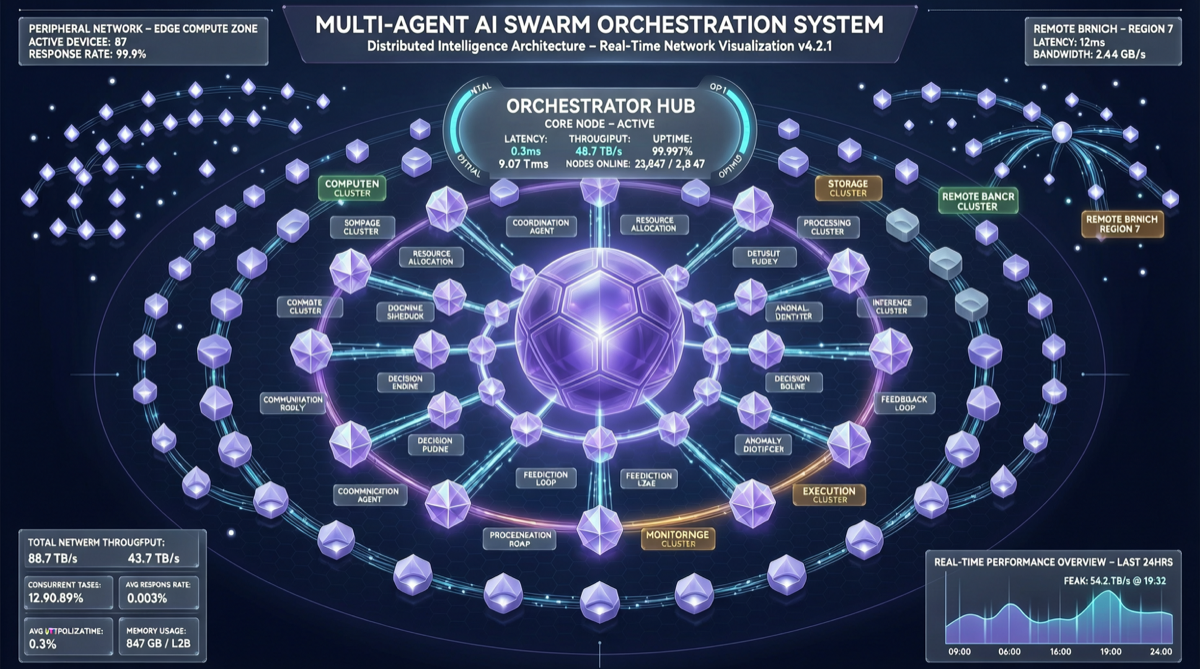
Core Change: From Solo Operator to Swarm Commander
The release of Hermes Agent v2.1 SWARM marks a fundamental shift in product positioning—no longer just an independent AI assistant, but a control platform that can coordinate multiple agents working collaboratively.
Key Components of the SWARM Architecture
| Component | Function | Problem Solved |
|---|---|---|
| Orchestrator Chat | Unified conversation entry point | Eliminates context switching between agents |
| Multi-Agent Control Plane | Parallel control of multiple agents | Task decomposition, resource allocation, progress tracking |
| Kanban TaskBoard | Kanban-style task management | Visualized workflows, clear agent division of labor |
| Reports + Inbox | Result aggregation and notifications | Consolidated output, reduced information fragmentation |
| TUI View | Terminal user interface | Developer-friendly operation |
The core design philosophy is “1 Orchestrator, 0 human intervention.” Once tasks are decomposed and assigned to individual agents, the Orchestrator coordinates execution, handles exceptions, and consolidates results. Humans only need to define goals and acceptance criteria.
Comparison with Similar Solutions
SWARM is not the first multi-agent framework, but its design approach has clear differentiators:
| Feature | Hermes SWARM | CrewAI | LangGraph | AutoGen |
|---|---|---|---|---|
| Agent Count | Unlimited | Limited | Limited | Limited |
| Orchestration Method | Central Orchestrator | Role collaboration | Graph structure | Conversational |
| User Interface | TUI + Desktop | CLI | Python API | Python API |
| Task Management | Kanban system | Built-in | Custom | Custom |
| Learning Curve | Low | Medium | High | High |
Hermes SWARM’s core competitive advantage: encapsulating the complexity of multi-agents behind a simple Orchestrator interface. Users don’t need to understand DAGs, state machines, or message queues—they just tell the Orchestrator “what I want done.”
Practical Application Scenarios
1. Content Production Pipeline
- Agent A: Research and data collection
- Agent B: Draft writing
- Agent C: Review and polishing
- Agent D: Formatting and publishing The Orchestrator passes context between stages, manages versions, and handles exceptions.
2. Code Refactoring Project
- Agent A: Code analysis and technical debt assessment
- Agent B: Module splitting and refactoring
- Agent C: Test case generation and execution
- Agent D: Documentation update The entire process is orchestrated by the Orchestrator; developers only review at key checkpoints.
3. Data Analysis Report
- Agent A: Data acquisition and cleaning
- Agent B: Statistical analysis and visualization
- Agent C: Insight extraction and narrative description
- Agent D: Report formatting and distribution
Getting Started Recommendations
- Start with a single agent: If you haven’t used Hermes Agent yet, familiarize yourself with the single-agent workflow before upgrading to SWARM
- Define clear task boundaries: SWARM’s efficiency depends on the quality of task decomposition. Vague tasks lead to context confusion between agents
- Leverage the Kanban board: Visualization is the core tool for managing multiple agents. Use the board to track each agent’s status and output
- Monitor Orchestrator logs: When coordination issues arise between agents, the Orchestrator logs are the most efficient debugging entry point
Judgment
Hermes SWARM’s direction is correct: the future of AI agents is not a single smarter model, but a system of collaborating models. However, at this stage, the intelligence level of the Orchestrator determines the SWARM’s ceiling. If the Orchestrator cannot accurately decompose tasks, handle conflicts, and merge results, more agents just mean more noise.
v2.1 is an important milestone, but there’s still distance to a truly mature “AI operating system.” Watch for improvements in Orchestrator intelligence and inter-agent communication protocols in v2.2 and beyond.