What Happened
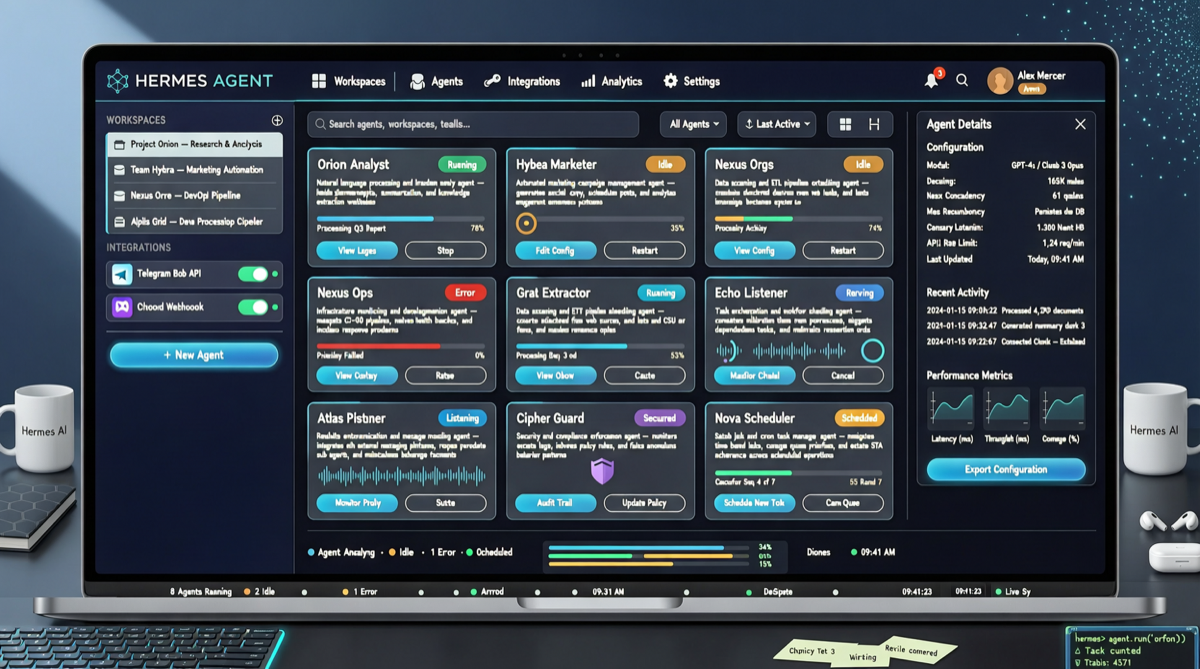
Hermes Agent officially released its desktop client in early May, upgrading the originally CLI-driven Agent framework into a complete virtual workspace. Core features include:
- Multi-Agent Parallel Management: Run multiple Agents simultaneously in a single window, each with independent sessions
- Cross-Model Provider Switching: Seamlessly switch between different backends like DeepSeek, Ollama, OpenClaw
- Cross-Platform Session Sync: Desktop, web, and mobile session states sync in real-time
- Social Channel Integration: Built-in Telegram and Discord Bot integration, deploy Agents to group chats with one configuration
- ChatGPT-Level Interface: File uploads, knowledge base management, code execution all graphical, no terminal needed
The announcement tweet received 813 likes and 1,126 bookmarks, with over 90,000 views — community response far exceeded expectations.
Why It Matters
The “iPhone Moment” for Agent Frameworks
Before this, running and managing multiple Agents required juggling multiple terminal windows, manually configuring environment variables, and separately managing API Keys. The Hermes desktop app encapsulates all of this into a unified GUI — this isn’t just “adding an interface,” it’s a critical leap for Agent frameworks from “developer toys” to “productivity tools.”
| Dimension | Before Desktop App | After Desktop App |
|---|---|---|
| Multi-Agent Management | Multiple terminal window switching | Single-window parallel Kanban |
| Model Switching | Edit config files | One-click dropdown menu |
| Social Channel Integration | Manual Bot deployment | Built-in integration wizard |
| File/Knowledge Base | Command-line operations | Drag-and-drop + graphical management |
| Learning Curve | CLI familiarity required | ChatGPT-like operation |
Impact on Existing Ecosystem
The Hermes desktop app takes a “full-stack open source + zero cost” approach, differentiating from these competitors:
- vs Anthropic Claude Desktop: Claude Desktop is bound to a single model; Hermes supports multiple providers
- vs OpenClaw: OpenClaw focuses on terminal interaction and code agents; Hermes desktop covers broader daily Agent scenarios
- vs Commercial SaaS: Enterprise Agent management platforms at $2,000/month, Hermes replaces with zero-cost open source
Technical Architecture Highlights
The desktop app still calls the core engine of the Hermes Agent open-source framework underneath, adding an independent desktop runtime layer:
┌─────────────────────────────────────┐
│         Hermes Desktop GUI          │
│  ┌──────────┬──────────┬──────────┐ │
│  │ Agent #1 │ Agent #2 │ Agent #3 │ │
│  └──────────┴──────────┴──────────┘ │
├─────────────────────────────────────┤
│    Session Sync  │  Model Router    │
├─────────────────────────────────────┤
│  Telegram  │  Discord  │  Webhook   │
├─────────────────────────────────────┤
│  DeepSeek  │  Ollama   │ OpenClaw  │
└─────────────────────────────────────┘
How to Use It
Scenario 1: Personal AI Studio
A freelance developer can simultaneously run:
- Agent A: Code review Agent (connected to GitHub)
- Agent B: Technical writing Agent (connected to knowledge base)
- Agent C: Customer communication Agent (connected to Telegram)
Three Agents run in parallel in the same window, no need to repeatedly switch contexts.
Scenario 2: Small Team AI Infrastructure
A 5-person team doesn’t need expensive enterprise Agent platforms:
- Install Hermes desktop app
- Connect to DeepSeek API (low cost) or local Ollama (zero cost)
- Configure Discord Bot as unified team entry point
- Share knowledge base for all Agents
Scenario 3: Multi-Channel Customer Service
- Desktop app manages the main Agent
- Connect personal users via Telegram
- Connect community users via Discord
- Conversation history and context from all channels sync automatically
Landscape Assessment
The release of the Hermes desktop app signals a trend: In 2026, AI Agent competition is no longer just about model capability, but has entered an “interaction layer + ecosystem layer” arms race.
OpenClaw dominates terminal and coding scenarios, while the Hermes desktop app focuses on general Agent management and multi-scenario coverage. Their complementarity outweighs competition, and combined with Open Design Kanban’s orchestration capability, the open-source Agent ecosystem is forming a complete toolchain.
Action Recommendations:
- Users with Hermes CLI experience: Upgrade to desktop version directly, experience the efficiency boost
- Users who’ve never used Agent frameworks: Desktop version is the best entry path
- Enterprise users: Evaluate replacing $2,000/month commercial Agent management platforms with Hermes desktop