Core Conclusion
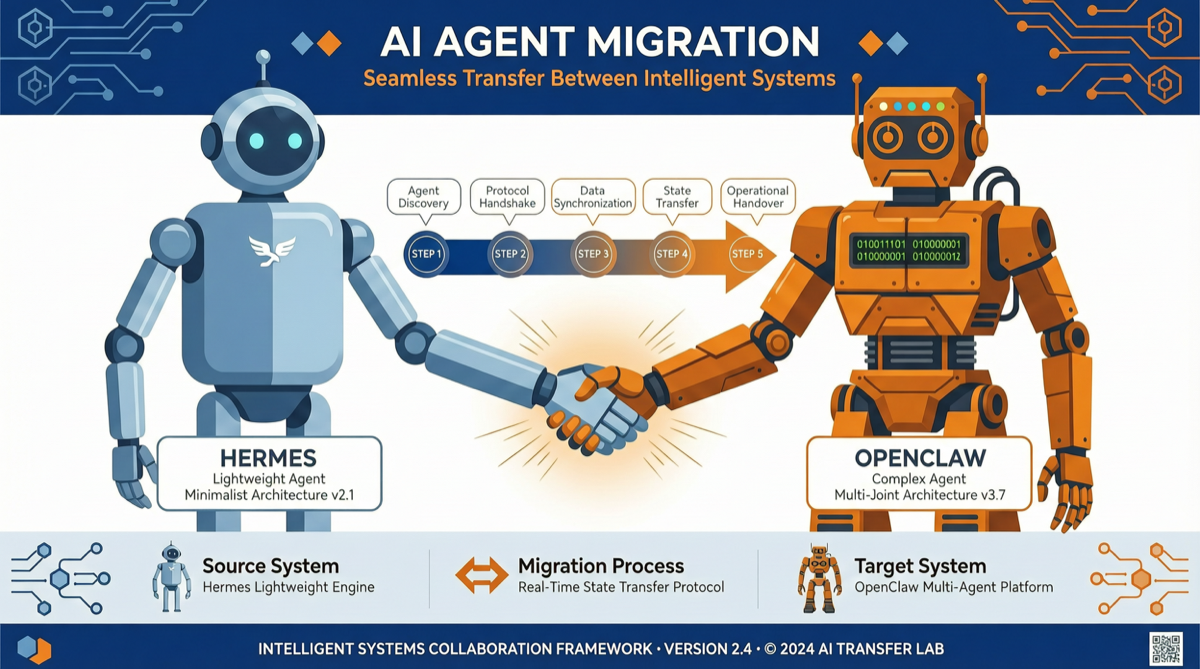
In spring 2026, a clear migration trend emerged in the AI Agent space: developers are moving from OpenClaw to Hermes Agent. This is not because OpenClaw is bad — on the contrary, OpenClaw is feature-rich and widely connected — but Hermes has formed a differentiated advantage in lightweight design, stability, and compositional freedom. For developers who want “their own AI, under their own control,” the Hermes + Ollama + open-source model combination is becoming the most cost-effective self-hosted solution.
Positioning Differences Between the Two Frameworks
| Dimension | OpenClaw | Hermes Agent |
|---|---|---|
| Design Philosophy | ”Connect everything” — pre-integrated with many services and tools | ”Minimal core” — focused on the Agent execution engine |
| Complexity | High — rich features but long dependency chain | Low — lightweight core, extensibility through composition |
| Stability | Prone to break on frequent updates | Conservative update strategy, backward compatible |
| Model Support | Binds to proprietary model routing | Supports any OpenAI-compatible API |
| Community Momentum | Early explosion, growth slowing | Continuously rising, many migrating users |
| Deployment | Docker all-in-one | Flexible: local/server/container |
Why Migrate? Three Real Signals
Signal One: Update Anxiety
Frequent feedback in the OpenClaw community:
“Every update breaks something. I am afraid to update OpenClaw now.”
Hermes update strategy is entirely different:
“It is super lightweight, super fast. The more you use it, the better it gets.”
This is not about feature quantity, but about stability expectations. For 24/7 running Agent systems, “not breaking” matters more than “new features.”
Signal Two: Cost Advantage
A typical OpenClaw monthly expense (medium usage):
- OpenClaw subscription: $20-50/month
- API calls (Claude/GPT): $30-100/month
- Total: $50-150/month
Hermes local setup:
- Hermes: Free and open-source
- Ollama (local inference): $0 (electricity cost negligible)
- Or Kimi K2.6 / Qwen API: $5-15/month
- Total: $5-15/month
For individual users with moderate daily activity and relatively fixed tasks, the cost difference is an order of magnitude.
Signal Three: Compositional Freedom
Hermes does not bind to any specific frontend or toolchain:
- Frontend: Open Web UI, Telegram, Discord, Web, CLI
- Models: Ollama local, Kimi K2.6, Qwen, GPT, Gemini
- Extensions: Access any tool via MCP protocol
This “Lego-style” composition lets users freely assemble based on their needs rather than being constrained by framework design decisions.
Hermes + Ollama + Open Web UI Quick Setup
Architecture
┌─────────────┐     ┌──────────────┐     ┌─────────────┐
│ Open Web UI │────▶│ Hermes Agent │────▶│   Ollama    │
│  (Frontend)  │     │ (Engine)     │     │ (Inference) │
└─────────────┘     └──────────────┘     └─────────────┘
Three-Step Deployment
# 1. Start Ollama (local model inference)
ollama pull qwen2.5:7b

# 2. Start Hermes Agent API server
hermes-server --model ollama/qwen2.5:7b --port 8080

# 3. Start Open Web UI frontend
docker run -d -p 3000:8080 \
  -e OLLAMA_BASE_URL=http://host.docker.internal:11434 \
  -e OPENAI_API_BASE=http://host.docker.internal:8080 \
  ghcr.io/open-webui/open-webui:main
Open http://localhost:3000 to use a ChatGPT-style interface with your local Agent.
Migration Checklist
| Item | OpenClaw | Hermes |
|---|---|---|
| Conversation history export | ✅ JSON support | ✅ JSON/SQLite support |
| MCP tool integration | ✅ Native | ✅ Supported |
| Telegram/Discord Bot | ✅ Built-in | ✅ Supported |
| Custom workflows | ✅ Visual editor | ⚠️ Requires code configuration |
| Multi-user collaboration | ✅ Supported | ⚠️ Basic support |
| Local inference | ⚠️ Limited | ✅ Native |
If you rely on OpenClaw visual workflow editor, migration requires adapting to Hermes code-style configuration. But if you value stability and cost control more, Hermes simple architecture is an advantage.
Landscape Judgment
The AI Agent framework market is diverging:
- OpenClaw route: All-in-one platform, feature-rich, for users who do not want to tinker
- Hermes route: Minimal core + free composition, for developers with customization needs
This is not a “who replaces whom” story, but a natural divergence of two user groups. But the trend is clear: as local model capabilities strengthen (Kimi K2.6, Qwen series), the “self-hosted + free composition” approach is evolving from a geek toy to a production-grade choice.
Action Items
- OpenClaw users: First run a simple scenario with Hermes (e.g., Telegram bot), compare the experience before deciding to migrate
- New users: If starting from scratch, go directly with Hermes + Ollama, avoiding later migration costs
- Enterprise users: Hermes auditability and local deployment capability are compliance advantages, but evaluate whether team collaboration features meet your needs
The barrier to self-hosted AI Agents is rapidly lowering. The key is no longer “can you set it up,” but “how to compose it best for your scenario.”