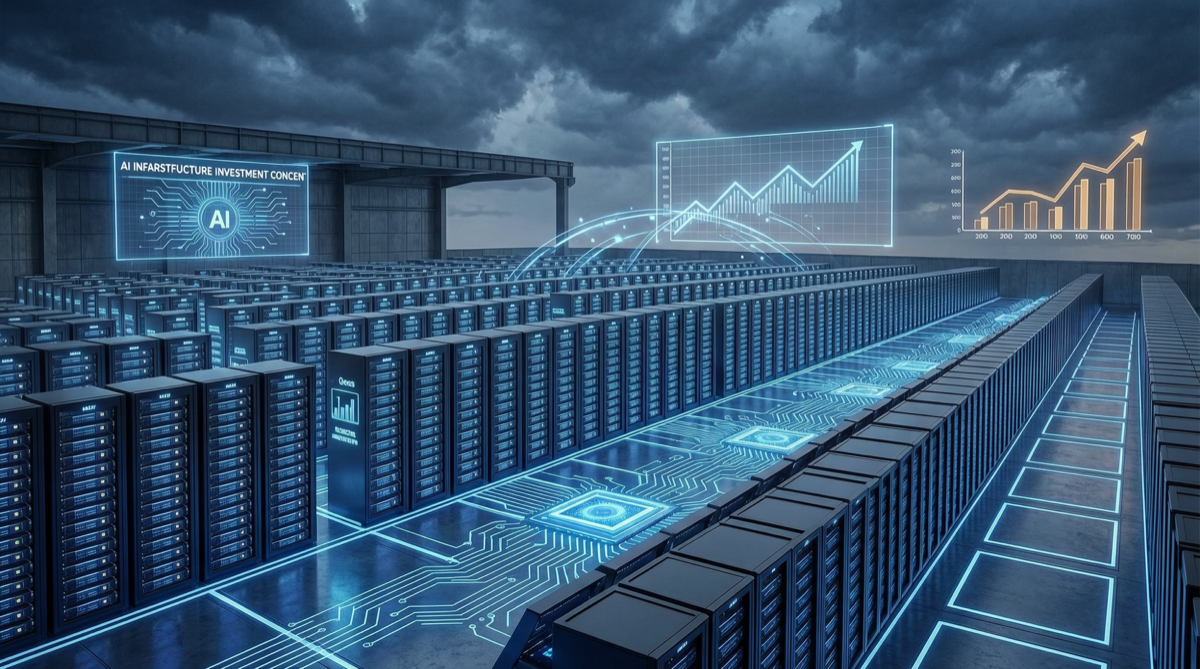
Conclusion: AI Infrastructure Investment Enters “Trillion-Dollar” Competition
WTS (Wall Street Technology Services) latest report again raised AI capital expenditure forecasts for five hyperscaler tech companies (Amazon, Alphabet, Meta, Microsoft, Apple):
- 2026: $805 billion
- 2027: $1.1 trillion
To understand the scale of this number: AI capital expenditure in 2026 alone roughly equals the combined capital expenditure of all non-tech companies in the S&P 500 in 2025. AI has moved from a tech industry investment theme to the investment focus of the entire economy.
Number Comparison: Exponential Growth in AI Investment
| Year | Five Giants AI CapEx | YoY Growth | Key Driver |
|---|---|---|---|
| 2024 | ~$200 billion | Baseline | Initial AI infrastructure |
| 2025 | ~$410 billion | +105% | Training cluster expansion |
| 2026E | ~$805 billion | +96% | Inference + training dual drive |
| 2027E | ~$1.1 trillion | +37% | Scaled inference deployment |
Key trends:
- Growth rate still astonishing: Nearly doubling from 2025 to 2026, but 2027 growth slows to 37%
- Inflection point signal: 37% growth rate, while still high, suggests investment peak may be approaching
- Inference share rising: Shift from “buying GPUs for training” to “building inference infrastructure”
Company Breakdown: Who Is Leading?
Based on Q1 earnings and forward guidance estimates:
| Company | 2026E CapEx | Q1 Actual | Core Investment | Strategic Logic |
|---|---|---|---|---|
| Meta | ~$225 billion | ~$30 billion | Llama open-source ecosystem + compute | Open-source AI standard setting |
| Microsoft | ~$190 billion | ~$38 billion | Azure AI + OpenAI | Cloud AI platform |
| ~$160 billion | ~$32 billion | TPU + data centers | Own chips + own cloud | |
| Amazon | ~$150 billion | ~$30 billion | AWS AI services | Ecosystem + investment dual line |
| Apple | ~$80 billion | ~$10 billion | Edge AI + chips | Device differentiation |
Meta highest budget reflects its comprehensive bet on open-source AI—not just model training, but also building infrastructure for the entire Llama ecosystem.
Morgan Stanley “Shock” Warning
Aligned with WTS capital expenditure raise, Morgan Stanley recently warned its clients: AI lab executives told investors to prepare for capability breakthroughs that will “shock” them.
Combined with capital expenditure data, the logical chain of this warning is:
- $805 billion investment → Massive compute expansion
- Compute expansion → Larger-scale training and inference
- Larger scale → Capability leap
- Capability leap → Fundamental business model change
Morgan Stanley wording is notable—not “gradual improvement,” but “shock.” This means they expect not 10-20% performance improvements, but capability breakthroughs that could change industry dynamics.
Three Stages of Investment Logic
Based on capital expenditure data, AI investment can be divided into three stages:
Stage 1: Compute Construction Phase (2023-2025) ✅ Basically Complete
- GPU procurement, data center construction
- Core driver: Training large models
- Main winners: NVIDIA, TSMC, cloud vendors
Stage 2: Inference Deployment Phase (2025-2027) 🔄 In Progress
- Inference optimization, edge deployment
- Core driver: AI application scaling
- Main winners: Inference optimization companies, AI application platforms
Stage 3: Application Explosion Phase (2026-2028) 🚀 About to Begin
- Agent economy, AI-native applications
- Core driver: AI creating direct revenue
- Main winners: AI-native application companies
We are in the middle of Stage 2. This means:
- Compute investment shifting from “buying GPUs” to “optimizing inference efficiency”
- Training costs starting to decline, inference costs becoming core competitive point
- AI application layer about to experience real explosion
Risks and Warnings
- Investment return uncertainty: $805 billion investment needs to generate corresponding revenue growth; AI direct revenue still far below investment
- Valuation bubble risk: Some AI-related company valuations have priced in overly optimistic growth expectations
- Regulatory uncertainty: EU AI Act and other regulations may increase compliance costs
- Technical route risk: If next-generation model architecture disrupts current paradigm, some infrastructure investment may depreciate
Action Recommendations
- Infrastructure investors: Focus on inference optimization, edge computing, AI safety—next-stage beneficiary directions
- Entrepreneurs: While giants invest in infrastructure, focus on application layer innovation
- Enterprise decision-makers: Evaluate build vs. buy AI infrastructure cost-benefit
- Individual investors: Watch AI sector valuation risk, focus on companies with actual revenue
$805 billion is not the endpoint, but the starting point of AI becoming economic infrastructure. But smart investors have already shifted from “who invests most” to “who invests most effectively.”