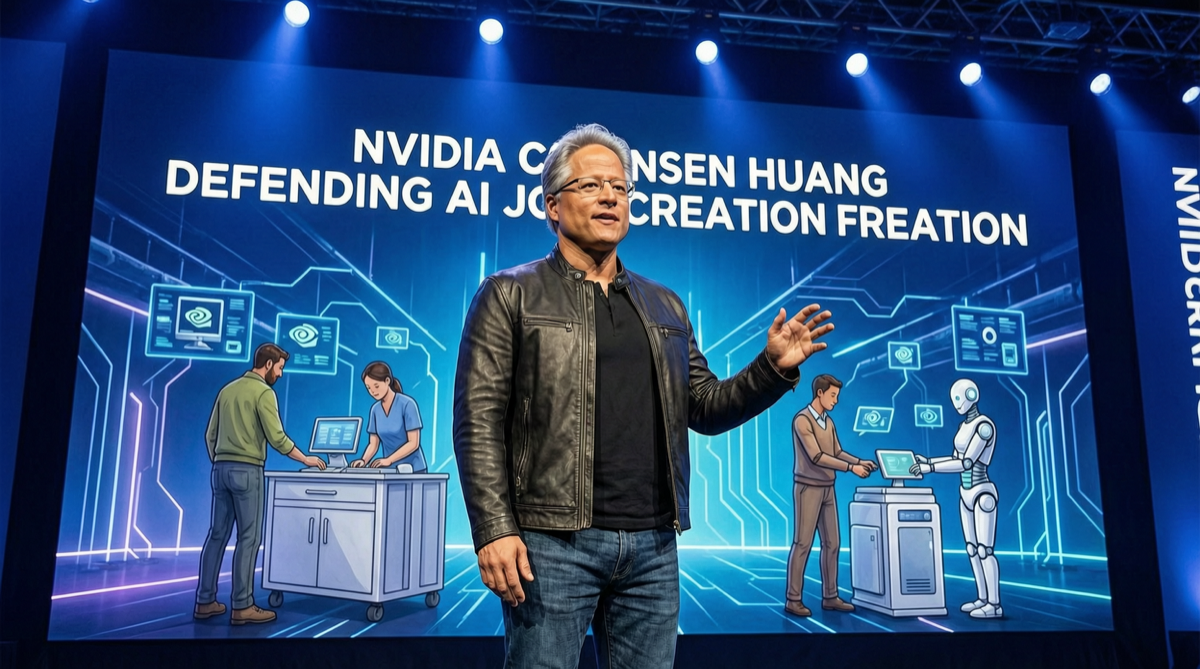
Is AI destroying jobs or creating them? The NVIDIA CEO has a clear answer.
From late April to early May 2026, Jensen Huang spoke out across multiple public platforms, pushing back against AI doomsday narratives:
- Memos to the President podcast: “AI has created more than half a million jobs. Companies that use AI grow faster. When they grow faster, they hire more people.”
- IEEE Medal of Honor speech: Engineers will drive the AI future, demand for technical talent will not decrease
- Public criticism: CEOs spreading claims that “AI will eliminate radiologists” or “don’t let kids study software engineering” have a “god complex,” and such comments are “not helpful” and even “hurtful”
Core Data
| Claim | Details |
|---|---|
| Job creation | AI has created 500K+ jobs |
| Company growth | Companies using AI grow faster |
| Hiring acceleration | Faster growth → more hiring |
| Economic impact | Trillions to be added to the economy |
| Engineer value | Engineers will be central to building and guiding AI systems |
The Other Side
Interestingly, as Huang spoke, another side emerged:
- Chinese court ruling (May 2): Companies cannot terminate employees solely to replace them with AI systems
- Some CEO narratives: Continue spreading views that AI will massively replace human workers
This collision reflects the complexity of AI’s impact on the labor market — not simply “replacement” or “creation,” but structural reorganization.
Landscape Assessment
Huang’s position aligns with NVIDIA’s commercial interests — the more AI compute demand, the more NVIDIA chips sell. But his core arguments are not baseless:
- Historical precedent: Every technological revolution (steam engine, electricity, internet) destroyed old jobs while creating more new ones
- Multiplier effect: AI lowers production costs → prices drop → demand increases → more people needed
- New job types: Prompt engineers, AI Agent operators, model fine-tuners — these didn’t exist 3 years ago
But structural unemployment risk is real. Huang’s “not learning AI is what gets you replaced” actually acknowledges that AI’s reshaping of the labor market is inevitable — just not necessarily in a net-negative direction.
Action Recommendations
- Individuals: Treat AI as a force multiplier, not a competitor. Mastering AI tools is more valuable than fearing replacement
- Enterprises: Plan talent transition paths alongside AI deployment, avoid the shortsighted “fire first, hire later” approach
- Educators: Re-examine curricula — don’t cancel coding education, but integrate AI-assisted coding into foundational teaching
Data Verification
Huang’s “500K jobs” figure needs further verification. While multiple sources cite this number, the original statistical methodology has not been made public. Readers should maintain cautious optimism — the trend of AI creating jobs is likely real, but exact numbers require more rigorous validation.