Core Conclusion
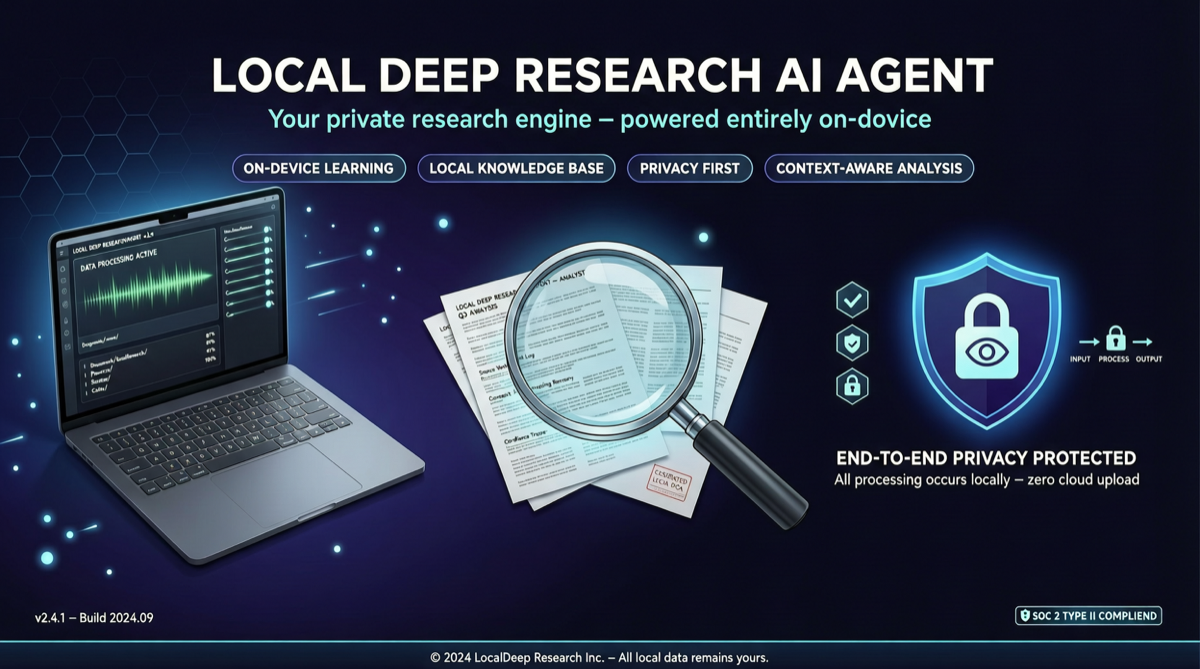
local-deep-research has hit the GitHub Trending daily list. This project implements a fully local deep research agent — from search, analysis to report generation, the entire process runs locally without relying on cloud APIs. In the context of increasingly strict data privacy regulations, this direction is worth watching.
Pain Point
Existing AI research tools (such as OpenAI’s Deep Research, Perplexity Pro) share a common problem: your research questions and intermediate analysis processes are sent to the cloud. For the following scenarios, this is unacceptable:
- Preliminary research for legal cases
- Literature retrieval for medical diagnosis
- Market analysis for corporate strategy
- Competitor research for investment due diligence
The common characteristic of these scenarios: research content involves trade secrets, personal privacy, or compliance-sensitive information.
local-deep-research’s Solution
The core architecture of local-deep-research:
| Component | Technical Solution | Description |
|---|---|---|
| Model Inference | Ollama / LM Studio | Run open-source models locally (Qwen3, Llama 3.5, DeepSeek V4, etc.) |
| Search Layer | Serper API / SearXNG | Serper is an external API (only sends search keywords), SearXNG can be fully deployed locally |
| Analysis Engine | Multi-round Iterative Agent | Search → Read → Summarize → Follow-up → Search again cycle |
| Report Generation | Local Template Engine | Structured output of research reports, supporting Markdown/PDF |
Workflow
1. User inputs research question
2. Agent generates search queries
3. Local/proxy search retrieves results
4. Agent reads and extracts key information
5. Determines if more search is needed (loop)
6. Synthesizes all information into final report
Comparison Analysis
| Tool | Deployment | Privacy Protection | Research Depth | Onboarding Difficulty |
|---|---|---|---|---|
| local-deep-research | Fully local | ⭐⭐⭐⭐⭐ | ⭐⭐⭐ | ⭐⭐⭐ |
| OpenAI Deep Research | Cloud | ⭐ | ⭐⭐⭐⭐⭐ | ⭐ |
| Perplexity Pro | Cloud | ⭐⭐ | ⭐⭐⭐⭐ | ⭐ |
| Claude Research | Cloud | ⭐ | ⭐⭐⭐⭐ | ⭐ |
| NotebookLM | Cloud | ⭐⭐ | ⭐⭐⭐ | ⭐ |
local-deep-research currently lags behind cloud solutions in research depth, mainly because:
- Local models have limited context windows and reasoning capabilities
- Search result quality and quantity depend on local models’ information extraction capabilities
- Multi-round iteration quality depends on the underlying model’s judgment
Getting Started Guide
Minimal Deployment
# 1. Install Ollama (model inference engine)
curl -fsSL https://ollama.com/install.sh | sh

# 2. Download recommended model (Qwen3 14B offers best price-performance)
ollama pull qwen3:14b

# 3. Clone the project
git clone https://github.com/LearningCircuit/local-deep-research.git
cd local-deep-research

# 4. Install dependencies
pip install -r requirements.txt

# 5. Run
python main.py --query "Your research question"
Hardware Requirements
| Configuration | Runnable Model | Research Speed |
|---|---|---|
| Mac M2/M3 16GB | Qwen3 8B | Medium |
| Mac M2/M3 32GB | Qwen3 14B | Fast |
| PC RTX 4090 24GB | Qwen3 32B / Llama 3.5 70B (quantized) | Fast |
| PC RTX 3060 12GB | Qwen3 8B (quantized) | Slow |
Landscape Assessment
Privacy-first local AI tools are forming a new category. The rise of local-deep-research is not accidental — it represents a core demand from enterprise users for AI tools: data sovereignty.
With the acceleration of the following trends, the market for localized research tools will continue to expand:
- GDPR and data privacy regulations becoming stricter worldwide
- Growing enterprise concerns about AI data leakage risks
- Continuous improvement of local inference hardware (Apple Silicon, NVIDIA RTX 50 series)
Action Recommendations
| Role | Recommendation |
|---|---|
| Individual Researchers | If you frequently research sensitive topics, local-deep-research is worth trying. Running Qwen3 14B on a Mac works well |
| Enterprise Users | Evaluate whether locally deployed research tools meet your compliance requirements. Serper API is the only external dependency, which can be replaced with SearXNG for fully offline operation |
| Developers | Watch the trend of local agent toolchains. The architecture of local-deep-research (search → analysis → report iterative loop) can be reused in other domains |