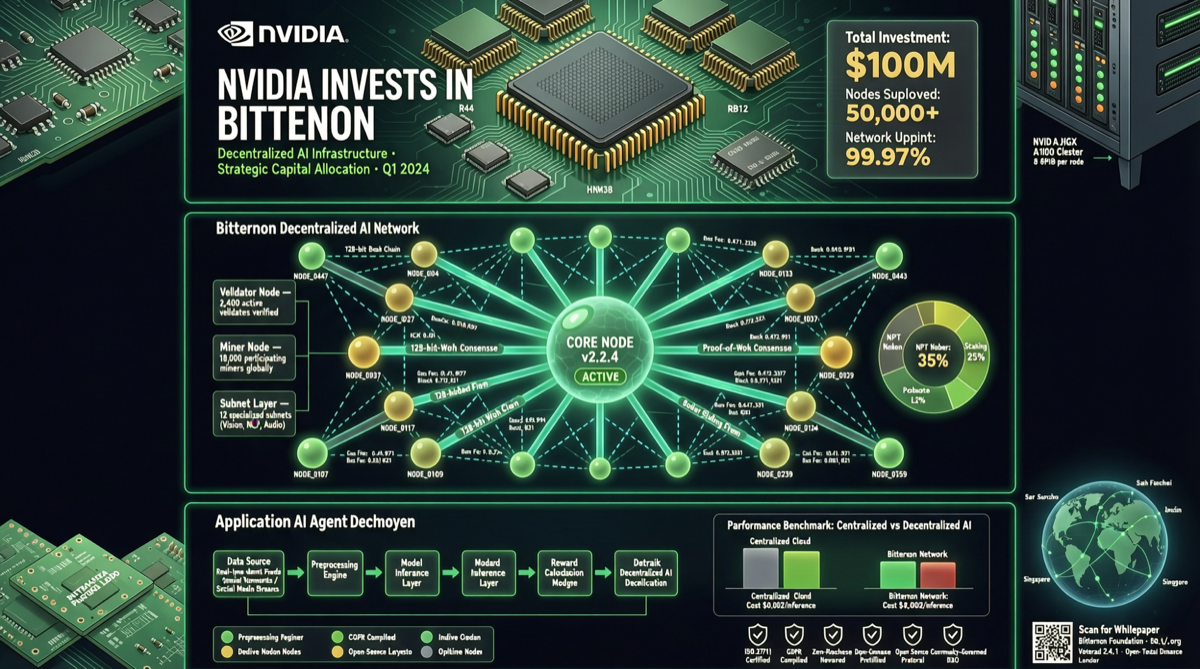
Core Conclusion
In Q1 2026, the Bittensor ($TAO) decentralized AI network received massive investment from a traditional tech giant:
| Investor | Amount | Details |
|---|---|---|
| Nvidia | $420M | 77% locked, Jensen Huang publicly praised the network |
| Polychain Capital | $200M | Additional exposure |
| Synaptogenix (NASDAQ) | $10M | Adopting TAO as treasury asset |
| Oblong | $8M | Adopting TAO as treasury asset |
This is not retail speculation, but institutional-level systematic positioning.
What is Bittensor?
Bittensor is a decentralized AI network with the following core concepts:
- Subnets: Each subnet focuses on a specific AI task (text generation, image generation, data labeling, etc.)
- Miners/Validators: Provide compute and models, earning TAO rewards through proof-of-work
- Market Pricing: The network automatically distributes rewards based on contribution quality, forming a decentralized AI services market
Simply put: Bittensor wants to turn “AI compute” into a tradable market like Bitcoin.
Why Did Nvidia Invest?
Nvidia’s investment logic can be understood at three levels:
1. New Channel for Compute Distribution
Nvidia sells GPUs to cloud providers (AWS, GCP, Azure), but these cloud providers are developing their own AI chips. Bittensor’s decentralized network creates a compute distribution channel that doesn’t depend on cloud giants — globally dispersed GPU compute can directly connect to the Bittensor network.
2. Defensive Investment
If decentralized AI becomes a mainstream trend, Nvidia needs a voice in this ecosystem. The $420M investment is essentially an “ecosystem entry ticket.”
3. Real AI Usage Revenue
The Bittensor network generated $43M in real AI usage revenue in Q1 2026. This proves that decentralized AI is not just a concept, but a network with actual commercial value.
Comparison: Centralized vs. Decentralized AI Infrastructure
| Dimension | Traditional Cloud AI (AWS/GCP) | Bittensor Decentralized Network |
|---|---|---|
| Compute Source | Centralized data centers | Globally dispersed GPU holders |
| Pricing Power | Cloud vendor monopoly | Market auto-regulation |
| Entry Barrier | High (requires large-scale procurement) | Low (single card can connect) |
| Revenue Distribution | Cloud vendor takes cut | Directly distributed to contributors |
| Censorship Resistance | Low (constrained by cloud vendor policies) | High (decentralized governance) |
The Signal Significance of Institutional Adoption
Two NASDAQ-listed companies adopting TAO as treasury assets — this signal is even more noteworthy than Nvidia’s investment:
- Public companies adopting crypto assets as treasury reserves means TAO is gaining enterprise-level recognition comparable to “digital gold”
- Bittensor infrastructure company Tao Alpha (LSE) is building subnet infrastructure
- Subnet count increased to 256, network scale continues to expand
Landscape Judgment
Nvidia’s investment in Bittensor is essentially laying the groundwork for “post-cloud” AI infrastructure. When decentralized compute networks mature, the traditional “cloud giants monopolize AI compute” landscape could be disrupted.
But the risks are equally apparent:
- Regulatory uncertainty: Crypto asset regulation in the US and China is tightening
- Technical maturity: Decentralized AI network performance and reliability still need validation
- Market volatility: TAO price is heavily influenced by crypto market cycles
Action Recommendations
- Understand Bittensor’s Subnet mechanism: Don’t just look at token price, focus on the network’s real AI usage volume
- Monitor regulatory developments: Public companies adopting TAO as treasury assets may trigger regulatory attention
- Separate “investment” from “technology evaluation”: Even if you don’t invest in the token, Bittensor’s technical approach is worth attention for AI practitioners
- Note the risks: $420M is a drop in the bucket for Nvidia, but a high-risk asset for ordinary investors