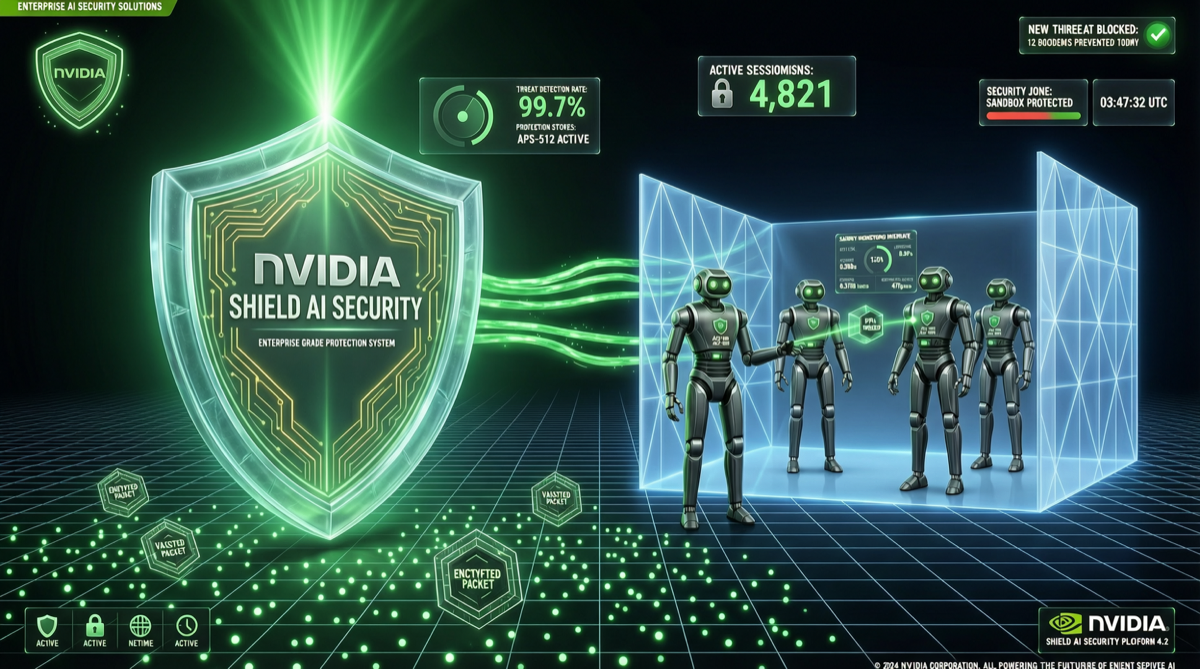
Core Conclusion
NVIDIA released two key products for enterprise AI Agents at GTC 2026:
- NemoClaw: Open-source stack adding built-in privacy and security controls to the OpenClaw Agent platform
- OpenShell: Enterprise-grade security sandbox that precisely controls what agents can access, share, and send
This is not another agent framework — it’s the final piece for agents entering production.
The Real Bottleneck for Enterprise Agent Deployment
By early 2026, the industry consensus was clear:
“Companies deploying agents at scale in 2026 aren’t solving AI problems. They’re solving organizational problems.”
| Pain Point | Traditional Approach | OpenShell Solution |
|---|---|---|
| Data leak risk | Network isolation + audit logs | Sandbox-level permission isolation, granular control |
| Rogue agent behavior | Manual approval workflow | Policy engine auto-interception |
| Compliance review | Post-hoc audit | Real-time output review + rollback |
| Deployment complexity | Custom integration over weeks | One command deployment |
NemoClaw + OpenClaw Technical Architecture
NemoClaw’s positioning is crystal clear: the enterprise-enhanced version of OpenClaw.
Key capabilities:
- Single-command deployment: No more complex integration work
- Built-in Nemotron model support: NVIDIA’s 30B MoE multimodal perception model as “eyes and ears”
- Open-source first: Any enterprise can adopt and audit the code
Academic Researcher Special Channel
NVIDIA also launched a virtual learning series specifically for academia with NemoClaw + OpenShell, helping researchers:
- Integrate agents with academic datasets
- Study agent behavior in controlled environments
- Gain practical guidance and security best practices
This shows NVIDIA’s strategy isn’t just about selling enterprise solutions — they’re cultivating the next generation of agent developers ecosystem.
Competitive Differentiation
| Solution | Security Capability | Deployment Difficulty | Open Source | Model Binding |
|---|---|---|---|---|
| OpenShell (NVIDIA) | Sandbox-level | Very low | Yes | Nemotron preferred, multi-model |
| AgentField | Cluster management | Medium | Yes | Unbound |
| LangGraph | Application-level | Medium | Yes | Unbound |
| CrewAI | Task-level | Low | Yes | Unbound |
| Enterprise custom | Deeply customized | Very high | No | Customizable |
OpenShell’s core advantage lies in the balance between security capability and deployment convenience, plus NVIDIA’s technical moat in GPU inference optimization.
How to Use
For Enterprise IT Teams:
- Start by deploying an isolated agent test environment with OpenShell
- Validate agent behavior against company security policies in the sandbox
- Gradually open permissions, starting with internal tool agents
For Developers:
- Add a security layer to existing OpenClaw agents with NemoClaw
- Use Nemotron 3 Nano Omni to enhance agent multimodal perception
- Canonical Ubuntu snap support makes deployment even simpler
Market Positioning
NVIDIA’s move is smart: rather than competing in agent frameworks, they position themselves as the provider of agent security infrastructure. As the OpenClaw ecosystem (175K+ stars) grows, enterprise demand for security grows exponentially — and NVIDIA is perfectly positioned.
With Nemotron 3 Nano Omni (30B MoE) as the perception layer, OpenShell as the security layer, and NemoClaw as the integration layer, NVIDIA is building a complete enterprise agent deployment stack.