Core Conclusion
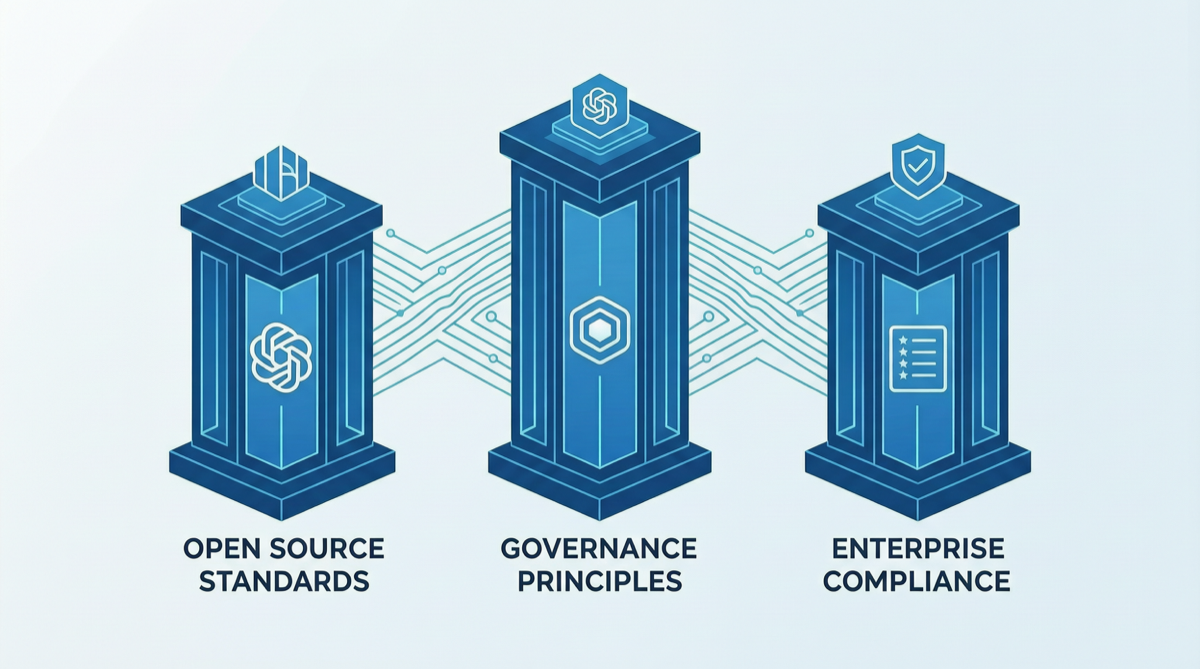
OpenAI released three signals in one week, which together point to a clear direction: transitioning from “model provider” to “enterprise AI infrastructure standard setter”.
None of these three items is explosive news on its own, but released in the same week, they convey a very clear strategic intent.
Three Developments Unpacked
1. Symphony Open-Sourced: The Orchestration Layer for Codex
Symphony is OpenAI’s orchestration specification for Codex Agents, defining a standardized interface for agent task description and coordination.
Key significance:
- Open ecosystem: Open-sourcing means third parties can build compatible orchestration tools on top of Symphony
- Competing with Anthropic MCP: Direct competition with Anthropic’s MCP protocol for control over agent interoperability standards
- Reducing migration costs: With standardization, enterprises can switch between agent frameworks without rewriting workflows
2. “Our Principles” Governance Statement
OpenAI published its first formal “Our Principles” public statement, including community safety commitments.
This might look like PR, but it carries special meaning at this moment:
- Anthropic’s CEO just publicly stated “coding is going away first, then all of software engineering”
- Industry anxiety about AI replacing developers has reached a peak
- OpenAI publishing principles now is defining the narrative of “responsible AI deployment”
3. Amended Microsoft Partnership + FedRAMP Moderate Certification
- Partnership amendment: Both sides renegotiated terms, details not fully public, but the direction gives OpenAI more independence
- FedRAMP Moderate: Achieved US federal government cloud security certification, meaning it can now take on government-level AI projects
The technical significance of FedRAMP: it requires systems to meet 325 security control standards. Earning this certification is a reassurance to enterprise customers.
Strategic Logic of the Combo
Looking at all three together:
| Move | Target Audience | Strategic Goal |
|---|---|---|
| Symphony open-source | Developer ecosystem | Establish agent orchestration standard |
| Our Principles | Public / regulators | Shape responsible AI image |
| FedRAMP + Microsoft amendment | Enterprise / government | Open B2G market |
This is a classic three-layer market advancement strategy:
- Lock in developers with open standards
- Appease regulators and the public with principles
- Open enterprise/government doors with compliance certification
Comparison with Anthropic
During the same period, Anthropic’s moves are:
- Hosting Code with Claude developer conference (May 6, SF)
- IPO targeting trillion-dollar valuation
OpenAI is taking the infrastructure route (standards + compliance), while Anthropic takes the product route (developer experience + brand). The two routes don’t conflict in the short-to-medium term, but long-term there will be a battle — who becomes the default layer for enterprise AI.
Market Positioning
- If Symphony succeeds, it could become the “Kubernetes” of the agent era — nobody wants to build a second orchestration standard
- FedRAMP certification opens up a trillion-dollar government AI procurement market
- The Microsoft relationship amendment means OpenAI’s capital independence is increasing
Action Recommendations
| Role | What to Watch |
|---|---|
| Developers | Evaluate whether Symphony spec is worth integrating into existing agent workflows |
| Enterprise IT | FedRAMP certification is an important plus for procuring AI services |
| Investors | OpenAI is expanding from C-end to B2G — valuation logic may change |