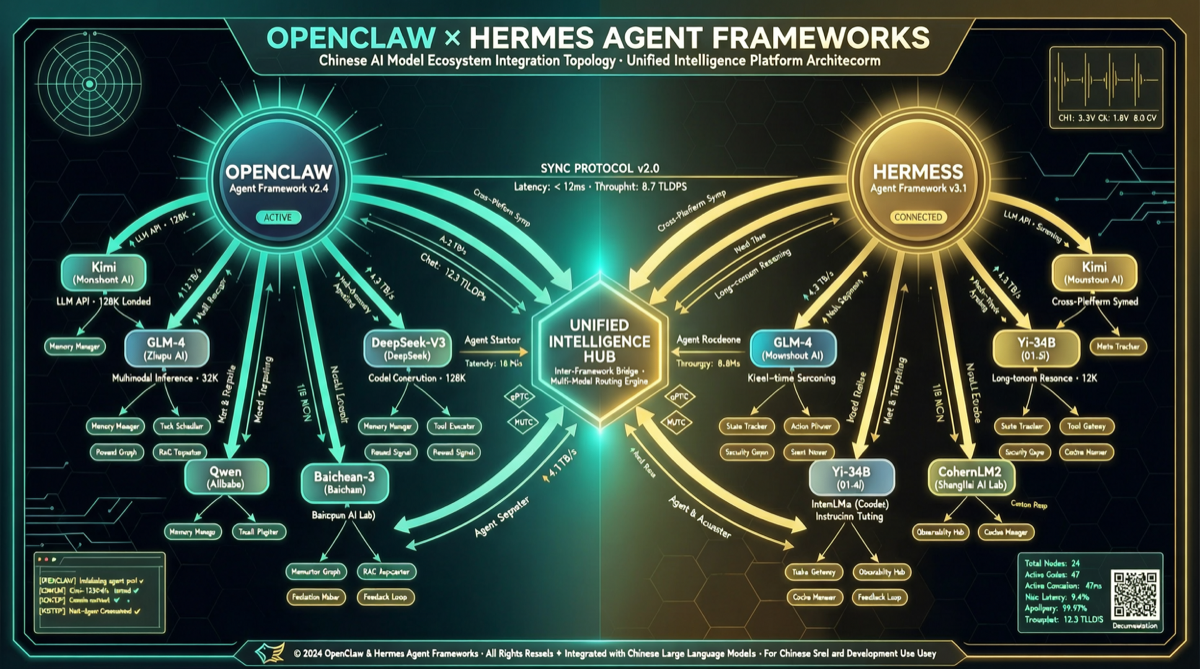
Core Conclusion: The “Android Moment” for Agent Frameworks
If 2025 was the “explosion year” for Chinese large models, then 2026 is becoming the “convergence year” for Chinese AI agent frameworks.
OpenClaw and Hermes Agent — currently the two most active open-source AI agent frameworks — have both significantly expanded their support for Chinese models in their latest releases. This isn’t just about “adding a few more API integrations” — it reflects a larger shift: the entire agent ecosystem is moving from “single-model-centric” to “framework as operating system, multi-model as applications.”
What Happened
OpenClaw: From Claude-Specific to Multi-Model Platform
OpenClaw was originally known for its deep integration with the Claude ecosystem, but recent updates have completely transformed this landscape:
- New Chinese model support: Kimi, MiniMax, Qwen and other models are officially included in the support list
- “auto (open)” model routing: Launched an automatic routing version that selects the best open-source model based on task characteristics
- 2026-04-29 version update: Introduced Computer Use capabilities, supporting cross-platform desktop-level agent operations
OpenClaw’s transformation reflects a broader trend: even agent frameworks originally designed for specific models are evolving toward being “model-agnostic.”
Hermes Agent: From Personal Workflow to Ecosystem Platform
Hermes Agent’s evolutionary path has been different. It was positioned from the start as a general-purpose AI workflow engine, and recent updates have further reinforced this direction:
- v0.12 release: Introduced Dashboard and Profiles features, making multi-agent management more intuitive
- ComfyUI creative workflow integration: Extended agent capabilities to image generation and creative workflows
- LM Studio native support: Allows locally deployed open-source models to seamlessly integrate with the agent framework
- Open-source reasoning traces dataset: Provides a new methodology for agent debugging and optimization
The “Bridge” Role of Platform Layer
Notably, third-party platforms like Little Dragon Cat are playing a “bridge” role:
- Simultaneous support for OpenClaw and Hermes: One of the few products globally providing user-friendly web interfaces for both frameworks
- Comprehensive domestic model integration: Kimi, GLM, DeepSeek and other models work with just an API Key
- Zero-configuration experience: Users don’t need to worry about underlying framework differences — the platform handles model selection and task distribution automatically
This “platform as bridge” model is accelerating the convergence between Chinese models and agent frameworks.
Three Key Trends in Ecosystem Convergence
Trend 1: Models as Plugins
Agent frameworks are abstracting models into “pluggable components.” Developers no longer need to write different integration code for different models — they connect any model through a unified interface.
This “model as plugin” architecture means:
- New models available immediately: When frameworks update their support list, all existing agents automatically gain new model capabilities
- Runtime switching: The same agent can use different models for different tasks
- Cost optimization: Dynamic model selection based on budget and performance requirements
Trend 2: Agent Frameworks as Operating Systems
When agent frameworks support multiple models, multiple tools, and multiple workflows, they’re evolving into an AI-era operating system:
- Resource management: Managing token budgets, context windows, concurrency limits
- Process scheduling: Deciding when to spawn sub-agents, when to reuse existing context
- Permission control: Managing agent access to file systems, networks, and APIs
- User interfaces: From CLI to web UI, to desktop integration
Hermes Agent’s Dashboard and OpenClaw’s Computer Use features are concrete manifestations of this trend.
Trend 3: Positive Feedback Loop of Open-Source Ecosystems
Chinese model open-source + agent framework open-source = powerful positive feedback loop:
- More open-source models → Agent frameworks have more choices → Frameworks attract more developers
- More developers → Richer framework ecosystem → Open-source models gain more users and feedback
- More users → Both models and frameworks get improvement momentum → Overall ecosystem capability rises
Once this loop starts, the acceleration only increases.
Practical Significance for Developers
What You Can Do Right Now
- Try multi-model routing: Enable automatic model routing in OpenClaw or Hermes to experience “the framework chooses models for you”
- Connect Chinese models: If your agent framework supports it, try connecting Kimi, GLM, or DeepSeek and compare performance differences
- Explore local deployment: Through the Hermes + LM Studio combination, experience fully localized agent workflows
Risks to Watch
- Model consistency: Different models may produce significantly different outputs for the same task — build robust error handling
- API stability: Chinese model APIs change frequently — establish automated compatibility testing
- Cost control: Token costs in multi-model environments can be harder to predict than single-model setups
Conclusion
The ecological convergence of OpenClaw and Hermes Agent isn’t about competition or cooperation between two projects — it’s a microcosm of a larger trend: AI agent frameworks are becoming the infrastructure connecting model capabilities with application scenarios.
When this infrastructure is mature enough, when Chinese models are diverse enough, and when developer tools are user-friendly enough, the adoption of AI agents will no longer be a question of “if” but “when.”
And that “when” may be closer than most people expect.