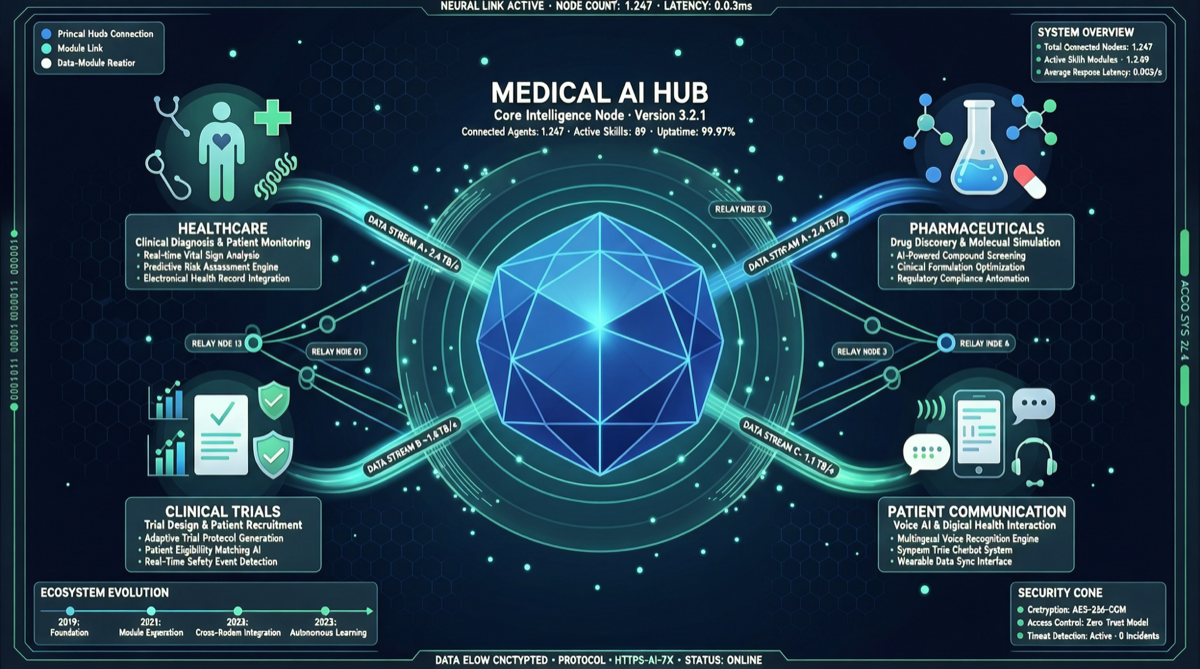
The New Battlefield for Agent Ecosystems
While everyone is still debating which framework is better — Hermes vs OpenClaw — the center of competition has quietly shifted: the quantity and quality of vertical domain Skills is becoming the key indicator that determines whether an Agent framework lives or dies.
In early May 2026, three data points emerged from the OpenClaw ecosystem:
- Medical domain Skills have reached 869
- An official free 18-step build-from-scratch tutorial has been published
- The plugin system went live, making on-demand installation possible
Medical Skills Ecosystem: What Does 869 Mean?
869 medical Skills is not an abstract number. It means developers can directly call on OpenClaw:
| Skill Category | Count | Typical Functions |
|---|---|---|
| Medical Record Processing | ~120 | Record summarization, ICD coding, clinical decision support |
| Imaging Analysis | ~85 | X-ray/CT/MRI report generation |
| Drug Interaction | ~150 | Drug-drug interaction checking, dose calculation |
| Clinical Trial Matching | ~90 | Patient enrollment criteria matching |
| Medical Literature | ~200 | PubMed search, paper summarization, evidence-level assessment |
| Patient Communication | ~70 | Discharge instructions, health education, multi-language translation |
| Operations Management | ~154 | Scheduling optimization, resource allocation, insurance coding |
These 869 Skills were not written by the OpenClaw team themselves — they are community-contributed. This ecosystem flywheel effect is the core reason OpenClaw can maintain its appeal against the strong competition from Hermes Agent.
18-Step Build-From-Scratch Tutorial
OpenClaw released a complete free tutorial, from environment setup to publishing your first Skill, in 18 steps:
- Install OpenClaw CLI
- Initialize project structure
- Configure LLM backend (supports GPT-5.5, Claude, Gemini, local models)
- Write your first Hello World Skill
- Add tool calling capability
- Configure memory system
- Implement multi-turn conversation state management
- Connect external APIs
- Error handling and retry logic
- Unit test Skill logic
- Performance optimization
- Security sandbox configuration
- Logging and observability
- Plugin packaging
- Publish to Skill marketplace
- Version management
- User feedback collection
- Continuous integration and deployment
The value of this tutorial: it lowers the barrier to Agent development, enabling more people to participate in building vertical domain Skills.
Plugin System: Install On Demand
The new plugin system solves a core pain point of Agent frameworks: bloat.
Previously, installing an Agent framework meant downloading every feature. Now OpenClaw supports:
openclaw plugin install @openclaw/medical-core
openclaw plugin install @openclaw/pharma-interaction
openclaw plugin install @openclaw/clinical-trial-matcher
Each plugin is independent, version-controlled, and can be updated separately.
Comparison with Hermes Agent
| Dimension | OpenClaw | Hermes Agent |
|---|---|---|
| Vertical Skills count | 869+ (medical) | Catching up |
| Learning curve | 18-step tutorial, gentler | Achievements + Curator system more flexible |
| Plugin ecosystem | Live, on-demand install | Skill system more mature |
| Model support | Multi-backend (cloud + local) | Latest support for Gemma4 (vllm) |
| Community activity | Tutorial + medical vertical explosion | v0.12.0 introduces Curator self-improvement |
Action Recommendations
- If you’re a developer: Start with the 18-step tutorial, pick a vertical domain you know, and contribute your first Skill
- If you’re a medical professional: Pay attention to the review and quality control of medical Skills; AI Agent applications in healthcare require rigorous validation
- If you’re choosing an Agent framework: Don’t just look at the framework’s own features — look at its vertical domain ecosystem and plugin count
The competition among Agent frameworks has shifted from “who has more features” to “who has a richer ecosystem.” OpenClaw’s 869 medical Skills is a signal: verticalization is the next explosion point for Agents.