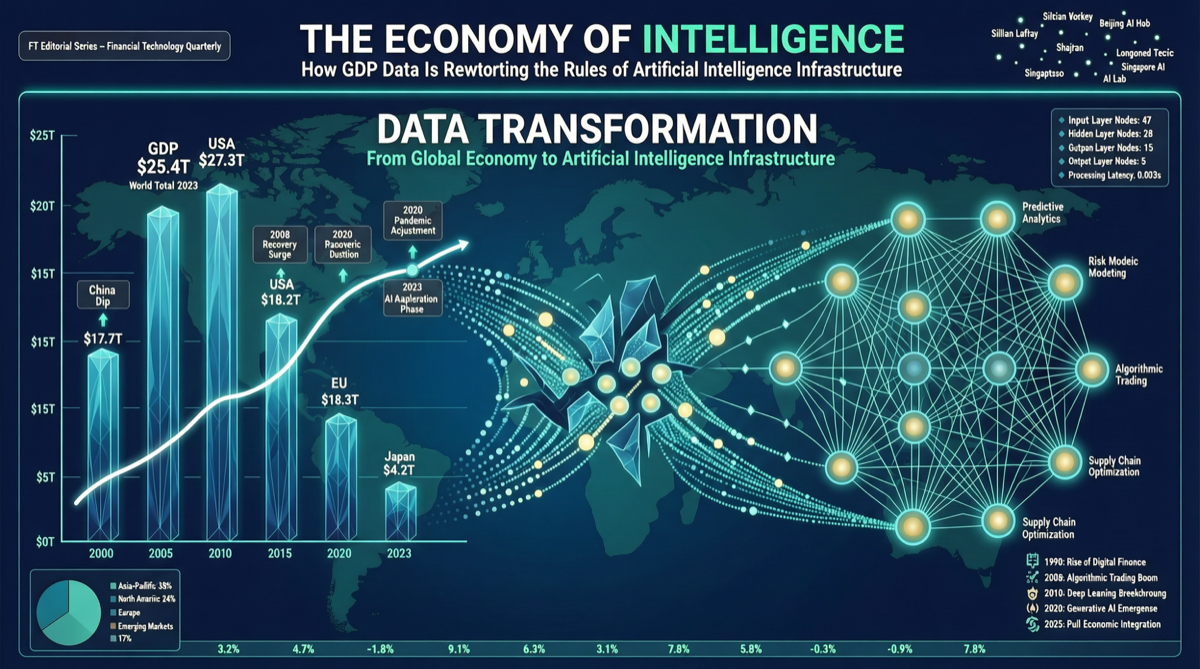
In late April 2026, a seemingly simple yet highly disruptive valuation framework rapidly spread through investment circles: using P/GDP (Price-to-GDP, market cap to addressable GDP ratio) rather than traditional P/S (price-to-sales) or EV/ARR (enterprise value to annual recurring revenue) to evaluate LLM companies.
The proposer’s logic is straightforward to the point of being almost brutal: Large models consume not just the software market, but an increasing number of real production segments. So the valuation anchor for LLM companies should not be how much subscription revenue they collect now, but how much of the GDP-created value they ultimately capture.
Why Traditional Valuation Frameworks Have Failed
Look at current AI valuations:
| Company | Valuation/Market Cap | Annual Revenue (Est.) | Traditional P/S | Problem |
|---|---|---|---|---|
| OpenAI | $300B+ | ~$15B | ~200x | Absurdly expensive by software company standards |
| Anthropic | $60-80B | ~$3B | ~20-27x | Growth rate extremely high but base still small |
| Moonshot AI (Kimi) | ~$18B | Not public | Not calculable | Revenue scale opaque |
| DeepSeek | Not public | Not public | N/A | Low-price strategy, slow revenue growth |
By software company standards, these valuations are all “absurdly expensive.” But what if AI models’ endgame is not “another SaaS” but “infrastructure-level general productivity tool”?
The Core Logic of the P/GDP Framework
The P/GDP valuation derivation chain:
Total GDP → AI-penetrable GDP percentage → LLM capturable value share → Reasonable valuationStep 1: AI-Penetrable GDP Percentage
According to McKinsey’s 2023 estimate, generative AI’s impactable global economic value is approximately $2.6-4.4 trillion/year, about 3-5% of global GDP. But this is only “direct impact”—indirect impact may be larger.
By 2026, with the maturation of Agent systems, this percentage is rising rapidly:
- Coding work: AI can already complete 30-50% of development tasks
- Customer service and content: AI penetration exceeds 40%
- Financial analysis and legal documents: AI-assisted coverage exceeds 60%
Step 2: LLM Capturable Value Share
Not all GDP affected by AI will convert to LLM company revenue. But even capturing just 10-20%, the numbers are staggering:
| Scenario | Penetrable GDP | LLM Capture Rate | Annual Revenue Potential | Reasonable Valuation (10x Revenue) |
|---|---|---|---|---|
| Conservative | $2.6T | 5% | $130B | $1.3T |
| Neutral | $3.5T | 10% | $350B | $3.5T |
| Aggressive | $4.4T | 15% | $660B | $6.6T |
Step 3: P/GDP Multiple Calibration
Referencing historical valuations of other “platform-level” technologies:
- Internet peak: Global internet-related industry valuations accounted for about 15-20% of global GDP
- Mobile internet: At peak, about 8-12% of global GDP
- AI/LLM: If reaching internet-level influence, the percentage could reach 5-10%
Global GDP is approximately $100 trillion. 5% is $5 trillion. If the LLM industry as a whole is worth $5 trillion, and OpenAI + Anthropic + Google AI + Meta AI capture 60-70% of that, the valuation space for leading companies is far from touching the ceiling.
Applicability and Limitations of This Framework
Applicable scenarios:
- Evaluating LLM companies in high-growth phases with small revenue bases
- Comparing AI company valuations across different countries (China vs. U.S. vs. Europe)
- Determining whether current valuations are bubble or reasonable pricing
Fatal limitations:
- “Penetrable GDP” estimates are highly uncertain: Different institutions’ estimates can vary by multiples
- Capture rate cannot be precisely modeled: Depends on competitive landscape, pricing power, and technological moats
- Ignores time value: GDP penetration may take 10-20 years, and the discounted present value is significantly reduced
- Policy risk is not priced: Regulation, antitrust, data security could significantly compress the addressable market
U.S.-China AI Company P/GDP Comparison
Using this framework for Chinese AI companies yields interesting conclusions:
| Company | Valuation | China GDP Penetrable Percentage | Implied P/GDP | Discount vs. U.S. Peers |
|---|---|---|---|---|
| Moonshot AI | $18B | ~3% (China market) | ~0.6% | About 70-80% discount |
| DeepSeek | Not public | ~3% | Not calculable | — |
| Zhipu | Not public | ~3% | Not calculable | — |
If Chinese AI companies’ endgame market is primarily China (GDP about $18 trillion, 18% of global), then their valuation ceiling is naturally lower than U.S. companies targeting the global market. But considering the global influence of DeepSeek V4 and Qwen 3.6, the “China market only” assumption may be too conservative.
Investor Action Guide
If you’re evaluating AI company investments:
- Use the P/GDP framework as a “ceiling test”—how much room remains between current valuation and theoretical upper limit
- Focus on “GDP penetration speed” rather than “current revenue”—penetration speed determines valuation expansion pace
- Be wary of P/GDP framework abuse—it’s not a precise calculation formula, but a qualitative thinking tool
If you’re building valuation models for AI companies:
- Traditional DCF and P/GDP frameworks should be used in parallel, cross-calibrating each other
- Include “model capability iteration speed” in core assumptions—faster iteration means faster GDP penetration
- Watch open-source model erosion of pricing power—DeepSeek V4’s low-price strategy is compressing the entire industry’s revenue space
Judgment
The P/GDP valuation method is not perfect, but it answers a question that traditional frameworks cannot: If AI models’ endgame is to reshape the production methods of the global economy, then measuring them by software company valuation methods is inherently wrong.
Whether OpenAI and Anthropic’s valuations are “expensive” depends not on their current revenue, but on the speed and depth of AI’s GDP penetration. If penetration speed exceeds expectations, current valuations may just be the beginning; if penetration is blocked, these valuations could become a generation’s lesson.
For Chinese AI companies, the implications of the P/GDP framework are more complex: on one hand, China’s massive economy and manufacturing base provide unique scenarios for AI penetration; on the other hand, geopolitical restrictions may compress the addressable global market.
Valuation is never just a math problem—it’s pricing the future world.