Bottom Line First
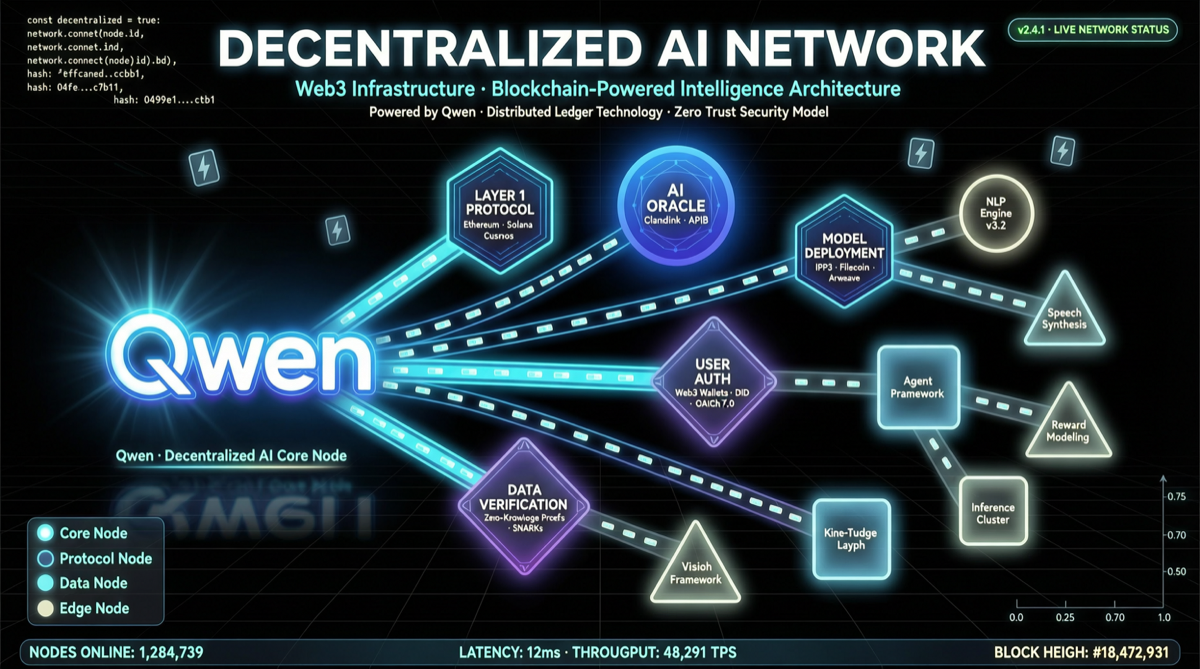
The Qwen × 0G partnership marks the first time a major Chinese AI model has formally entered the decentralized infrastructure layer. Previously, Qwen’s open strategy focused on open-sourcing weights and API services. This partnership directly embeds Qwen’s inference capability into a Web3 network, meaning developers can call Qwen through decentralized nodes without relying on Alibaba Cloud’s centralized API gateway.
This goes far beyond “another partnership announcement”: it is reshaping the question of “who controls the AI access gateway.”
What Happened
0G (Zero Gravity) is a Web3 infrastructure project focused on building a decentralized AI service network. The core components of this partnership include:
- Decentralized model routing: Qwen models will be deployed across 0G’s distributed network nodes. Developers can invoke them directly through blockchain addresses, without registering for an Alibaba Cloud account.
- Permissionless access: Bypasses the account systems and rate limits of traditional APIs. Any user with a wallet address can send inference requests.
- On-chain payment settlement: Inference costs are automatically settled via cryptocurrency, eliminating friction from cross-border payments and fiat currency exchange.
- Community-governed pricing: Model invocation prices will be dynamically adjusted by 0G’s governance mechanism, rather than being set unilaterally by Alibaba Cloud.
Why This Is a Strategic Shift for Qwen
Qwen’s open strategy so far has followed a clear trajectory:
| Phase | Strategy | Control Point |
|---|---|---|
| 2024 | Open-source model weights | Model distribution controlled, inference still via Alibaba Cloud |
| 2025 | Open API + DashScope | API economy, pay-per-token |
| 2026 | 0G decentralized partnership | Inference gateway begins decentralizing |
This is a clear strategic escalation: from “open-source but not open access” to “even the inference gateway is opening up.”
Comparison with Alternatives
| Dimension | Qwen × 0G | OpenAI API | Self-hosted Qwen |
|---|---|---|---|
| Account system | Wallet address | Email/phone | None |
| Rate limiting | Network-level dynamic adjustment | Fixed quota | Hardware-limited |
| Cross-border access | ✅ No geographic blocks | ❌ Restricted in some regions | ✅ |
| Payment barrier | Cryptocurrency | Credit card | None |
| Cost certainty | Variable (governance pricing) | Fixed | Fixed (hardware cost) |
Landscape Assessment
Impact on developers:
- If you are outside mainland China, this partnership means you can access Qwen directly without dealing with Alibaba Cloud’s international account registration process.
- If your application requires high availability and censorship resistance, decentralized routing is more reliable than a single API provider.
- The tradeoff: cryptocurrency payment barriers and token price volatility add complexity.
Impact on the industry:
- Qwen is the first Chinese top-tier model to take this route. If this model succeeds, DeepSeek, Kimi, and GLM will likely follow.
- Web3 infrastructure projects (0G, Bittensor, Akash) are now entering a “model provider争夺战” — a war for AI model partnerships.
- OpenAI and Anthropic are unlikely to go this route in the near term — their business models are heavily dependent on centralized API revenue.
Actionable Advice
- Developers already using Qwen API: Wait and see. The performance and latency of the decentralized version still need validation.
- Teams needing censorship-resistant AI access: This is currently the most promising option. Start building a test environment early.
- Web3 projects: If you are working on AI × Crypto, Qwen’s entry means the ecosystem is maturing. Start planning integrations now.