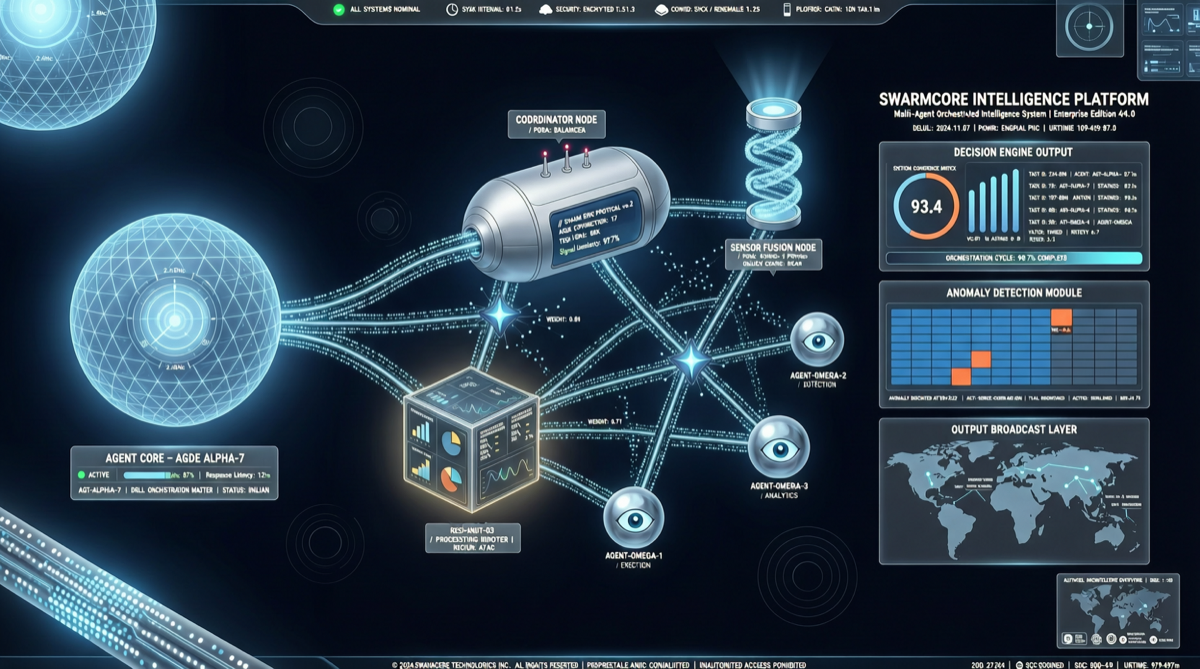
Pain Point: The Complexity of Agent Orchestration
As AI Agents evolve from “single chatbots” to “multi-agent collaboration systems,” developers hit a thorny problem:
- How do multiple agents divide and coordinate work?
- How is information passed and synchronized between agents?
- How do you manage the autonomous decision boundaries of agents?
- How do you ensure system observability and controllability?
Ruflo’s answer: Swarm Intelligence architecture.
Solution Core
Ruflo is a multi-agent orchestration platform oriented toward the Claude ecosystem, with core features:
Architecture Design
| Layer | Function | Technical Implementation |
|---|---|---|
| Agent Layer | Independent agent instances | Claude API + custom role definitions |
| Swarm Layer | Agent group coordination | Self-learning routing algorithm |
| Orchestration Layer | Workflow definition | YAML/JSON declarative configuration |
| Integration Layer | External tool access | Native Claude Code / Codex integration |
Key Capabilities
Intelligent Multi-Agent Swarms. Not simply “multiple agents taking turns” — these are swarms with self-learning capabilities. Agents automatically optimize task allocation based on historical performance.
RAG Integration. Built-in Retrieval-Augmented Generation — agents can access enterprise knowledge bases instead of hallucinating from thin air.
Enterprise-Grade Architecture. Supports permission management, audit logs, rate limiting, and other enterprise requirements.
Native Claude Code / Codex Integration. Ruflo can directly dispatch programming agents to execute development tasks.
Competitive Analysis
Agent Orchestration Tool Comparison
| Tool | Stars | Agent Type | Learning | Claude Integration | Enterprise Features |
|---|---|---|---|---|---|
| Ruflo | 43,986 | Multi-Agent Swarm | ✅ Self-learning | ✅ Native | ✅ Complete |
| CrewAI | ~20K | Multi-Agent Roles | ❌ Fixed rules | ✅ API | Basic |
| LangGraph | ~15K | Graph-based Agent | ❌ Fixed flow | ✅ API | Basic |
| AutoGen | ~30K | Multi-Agent Dialogue | ❌ Fixed rules | ❌ Indirect | Partial |
| Dify | ~50K | Workflow Agent | ❌ Fixed flow | ✅ API | ✅ Complete |
Ruflo’s uniqueness lies in this: it is the only orchestration platform with “self-learning swarm intelligence” as its core selling point. Other tools either use fixed rules or static flows; Ruflo lets agent groups self-optimize their collaboration strategies.
Getting Started
1. Quick Experience
git clone https://github.com/ruvnet/ruflo
cd ruflo
# Configure Claude API Key
export ANTHROPIC_API_KEY=your_key_here
# Start
python main.py
2. Define Your First Swarm
swarm:
  name: research-team
  agents:
    - name: researcher
      role: "Information gathering and analysis"
      tools: [web_search, document_reader]
    - name: analyst
      role: "Data interpretation and insights"
      tools: [data_processor, chart_generator]
    - name: writer
      role: "Report writing"
      tools: [document_writer, formatter]
  strategy: self-learning
  feedback_loop: true
3. Connect Claude Code
Ruflo natively supports Claude Code integration, directly dispatching programming tasks to Agent Swarms:
- Code Review Swarm: Multiple agents review code from different dimensions
- Feature Development Swarm: Division of frontend, backend, testing
- Bug Fix Swarm: Automated pipeline for locating, fixing, and verifying
Why It’s Worth Watching
- Strong growth momentum: 2,400+ stars per day indicates real community demand
- Differentiated positioning: In the crowded agent orchestration space, “self-learning swarm” is a unique technical narrative
- Claude ecosystem dividend: As Claude’s penetration in programming grows, Ruflo’s integration advantage will compound
- Enterprise-ready: Not a toy project — has actual deployment capability
Risk Warnings
- The project is still rapidly iterating; APIs may be unstable
- Highly dependent on Claude API — if Anthropic adjusts pricing, it impacts costs
- Explainability of self-learning swarms is an unresolved problem — when agent groups self-optimize, how do humans understand the decision logic?
Ruflo represents a trend: agent orchestration is moving from “manually defined flows” to “swarm intelligence self-adaptation”. This is not just a technical upgrade — it’s a paradigm shift in development. From “commanding agents” to “guiding agent swarms.”