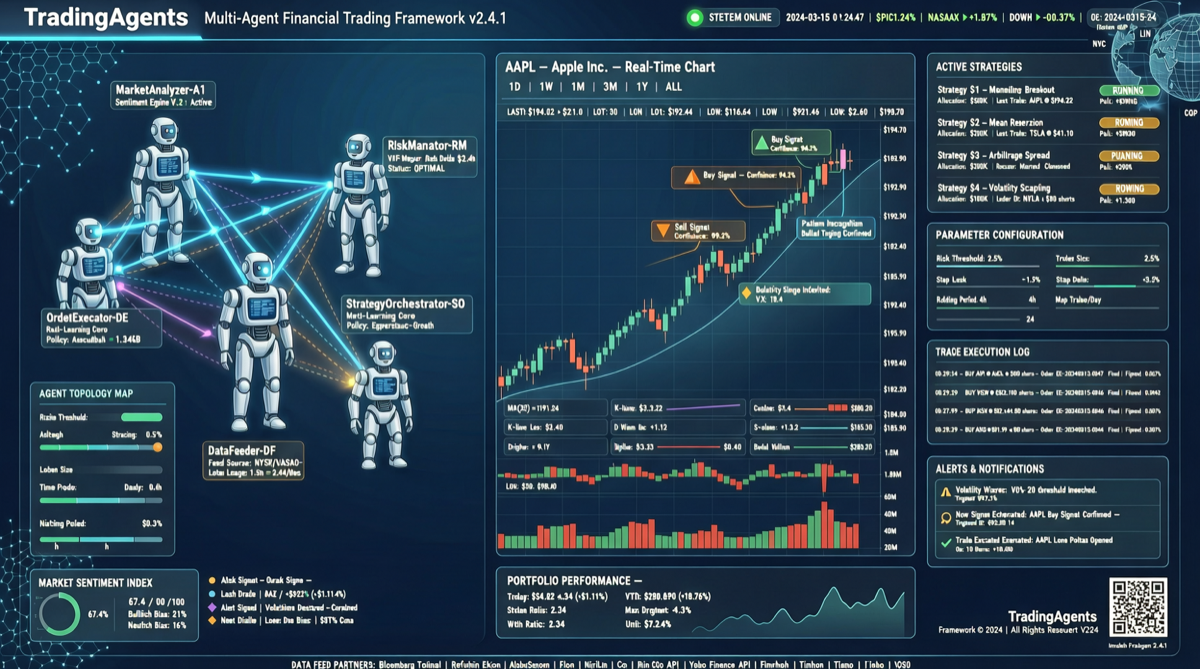
TradingAgents, a regular fixture on the GitHub Trending list, recently released v0.2.4. This multi-agent LLM financial trading framework developed by TauricResearch has accumulated 56,534 stars and 10,602 forks, averaging 386 new stars per day, making it one of the fastest-growing open-source projects in the AI agent domain.
What is TradingAgents
TradingAgents is a multi-agent financial trading framework based on large language models. Its core philosophy is to digitize the collaborative mode of real trading teams—different agents play roles such as analysts, risk officers, and traders, collaborating to complete the entire process from market research to trade execution.
v0.2.4 Update Content
This release, codenamed “structured agents,” includes the following improvements:
| Feature | Description | Value |
|---|---|---|
| Structured Agents | Agent output follows predefined structures, improving decision interpretability | Facilitates auditing and traceability |
| Checkpoint Recovery | LangGraph-based checkpoint mechanism for crash recovery | Production environment reliability |
| Memory Logging | Complete logging of agent decision processes | Strategy analysis and optimization |
| Docker Deployment | Full containerization support | Cross-platform deployment |
Multi-Model Support
The project now supports multiple model backends:
- OpenAI: GPT-5.5, GPT-5.5 Pro
- Anthropic: Claude Opus 4.7
- DeepSeek: V4 Pro
- Qwen: Qwen3.6-Plus
- Zhipu GLM
- Azure OpenAI
Architecture
TradingAgents’ multi-agent collaboration architecture simulates the workflow of a real trading team:
Market Research Agent → Fundamental Analysis → Technical Analysis → Risk Assessment → Trade Decision → ExecutionEach agent specializes in a specific domain, with a decision agent synthesizing inputs to generate trading strategies.
Why It Matters
TradingAgents represents a typical pattern for AI agent deployment in vertical domains—not using a single large model to solve everything, but letting multiple specialized agents collaborate on complex tasks. This architectural approach can be transferred to other domains requiring professional division of labor, such as legal due diligence, medical diagnostic assistance, and supply chain optimization.
Risk Warning: TradingAgents is a research-oriented framework; its outputs do not constitute investment advice. Financial trading involves real capital risk; always test thoroughly in simulated environments before use.