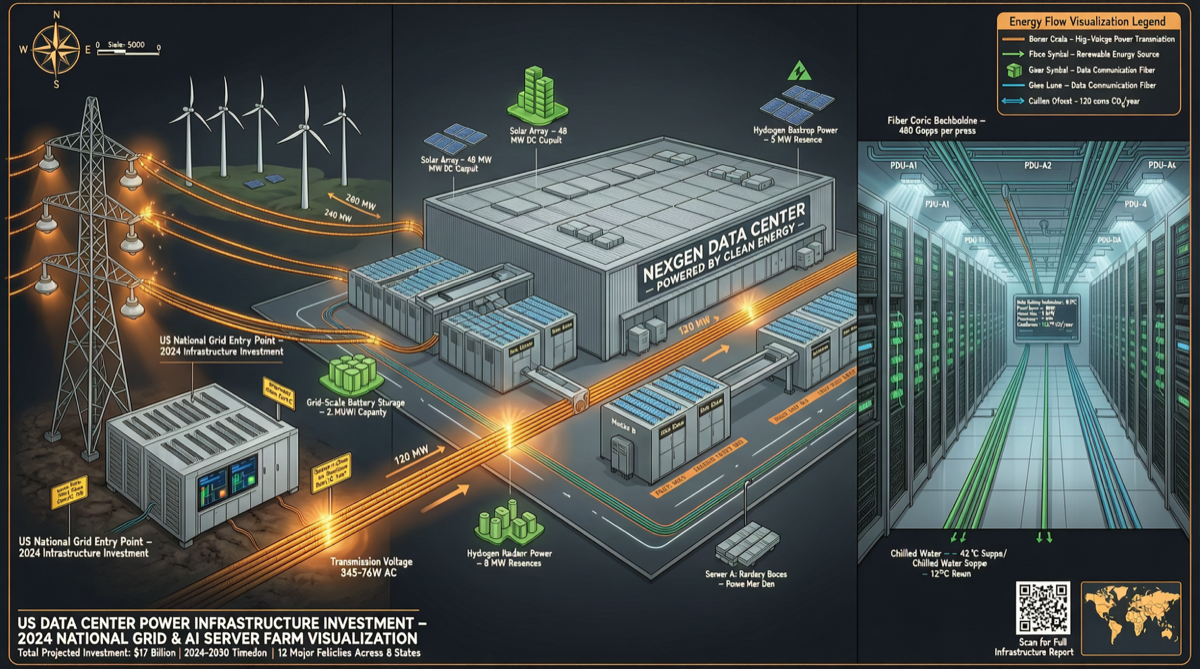
Key Data
| Metric | Data |
|---|---|
| Power equipment investment growth | Expected to triple by 2030 |
| Data center share | Approximately 40% of total investment |
| Driver | AI data center construction boom |
What Does This Mean?
AI’s demand for power is shifting from “worth paying attention to” to “infrastructure-level reshaping.”
The 40% data center share means this: for every $10 invested in upgrading power systems, $4 goes to serving AI compute. This is not a marginal demand—it is the power industry’s new growth engine.
Supply Chain Impact
Upstream: Power Generation
- Nuclear power: Small Modular Reactor (SMR) projects are accelerating, tech companies directly investing in nuclear plants
- Natural gas: Baseload power during the transition period, demand continues to grow
- Renewable energy: Wind/solar paired with storage solutions becoming standard for data centers
Midstream: Transmission & Distribution
- Transformers: Surging demand extending delivery cycles from months to 1-2 years
- Grid upgrades: Aging grids need expansion to support new loads
- Energy storage: Lithium batteries and pumped hydro storage as peak-shaving measures
Downstream: Data Centers
- Site selection logic shifting: moving from proximity to users toward proximity to cheap power
- Liquid cooling becoming standard: air cooling can no longer meet heat dissipation needs of high-density GPU clusters
- Self-built power: tech giants directly participating in power generation and transmission facility construction
Investment Opportunities
| Track | Rationale | Risk |
|---|---|---|
| Power equipment manufacturers | Certain beneficiaries, full order books | Capacity bottlenecks, raw material price increases |
| Grid infrastructure | Policy + demand dual drivers | Long approval cycles |
| Nuclear SMR | Clear long-term growth logic | Technology maturity and regulatory risk |
| Energy storage | Peak-shaking essential demand | Fierce price competition |
| Data center REITs | Rent growth expectations | Long construction cycles, interest rate sensitivity |
Connection to the Chinese Market
China’s situation is similar but more complex:
- The East Data West Computing project is already optimizing the geography of power and compute
- Domestic GPUs (Huawei Ascend, etc.) energy efficiency directly affects power demand
- China’s power system has higher flexibility, but grid investment faces similar pressures
What This Means for Your Decisions
For AI startups: Compute costs are not just about GPU prices—they also include power costs. Site selection needs to consider electricity prices and power supply stability.
For investors: Power infrastructure follows the “pickaxe and water seller” logic in AI investment—regardless of which model company wins, power demand will grow.
For developers: Energy efficiency optimization for model inference (such as FlashQLA, FlashKDA, and other projects) is not just a technical issue—it directly impacts operational costs.
Timeline Assessment
Tripling by 2030 implies a compound annual growth rate of approximately 20%. This is not a sudden explosion, but a structural growth trend lasting 4-5 years. Power infrastructure construction cycles are much slower than AI model iteration—this is a slow-moving variable, but the direction is clear.