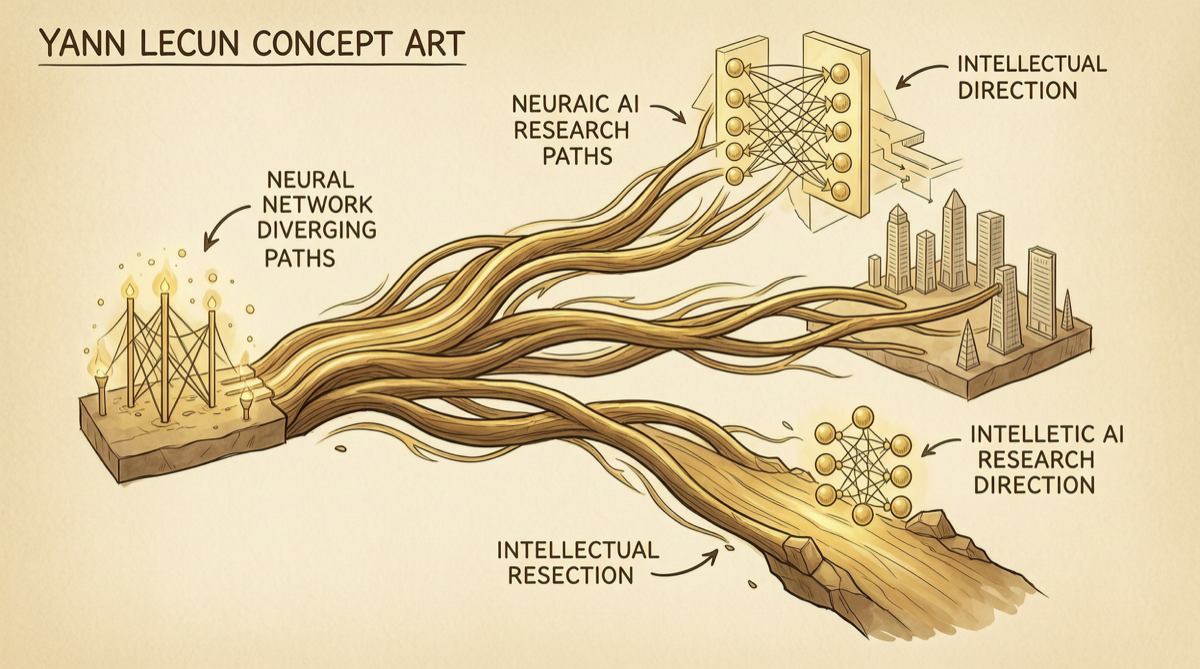
Yann LeCun — Turing Award winner, one of the “three giants” of deep learning, founder of Meta AI Research Lab — left the team he built over 12 years in November 2025. His departure came with a thought-provoking public statement:
“The AI industry is completely LLM-pilled. Everybody is working on the same thing. They’re all digging the same trench.”
The Core of LeCun’s Criticism: Loss of Diversity
LeCun’s criticism is not about LLMs themselves — he acknowledges their enormous success. His core argument is the high convergence of research directions:
- Almost all AI companies and research institutions are pouring resources into LLM scaling
- World Models, Embodied AI, and self-supervised learning are being marginalized
- Academic diversity is being squeezed by industrial “scaling arms races”
The “Post-LeCun Era” of Llama
Ironically, after LeCun’s departure, Llama’s influence in the open-source community has grown even further:
| Event | Time |
|---|---|
| Llama 4 released | April 2026 |
| Meta Muse Spark open-sourced | April 2026 |
| Llama community contributors exceed 10,000 | Q1 2026 |
Landscape Assessment
LeCun’s departure raises deeper questions:
- Is LLM the endgame for AI? LeCun believes it is not — he has always advocated that world models and embodied intelligence are closer to “true AI”
- Will Meta adjust its strategy? Short-term Llama investment is unlikely to decrease, but long-term research direction diversification may face challenges
- Does the open-source community need new “guardians”? Llama’s success owes much to Meta’s open-source strategy and LeCun’s team’s academic vision
Impact on Developers
- Short term: Llama development rhythm won’t change — April’s consecutive releases prove this
- Medium term: Watch whether Meta reduces investment in “non-LLM” directions
- Long term: If LeCun founds a new research institution, it could spawn new research directions and open-source projects